

The Paper Had a Second Anniversary
(Stars and Stripes, 1919)
– from Amazon:Read more …

– from Amazon:Read more …
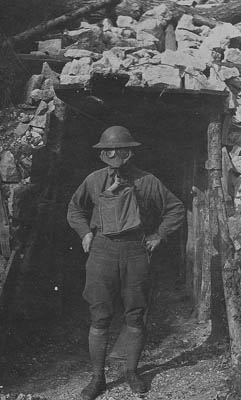
The World War I American uniform data attached herein answers the question as to how often Doughboy uniforms would wear out and need replacing. This information was all transcribed by U.S. Army Quartermaster Corps and published in a book titled THE OFFICIAL RECORD OF THE UNITED STATES IN THE WORLD WAR (1922).
In an attempt to save money, the U.S. Army issued an order that N.C.O.s were to wear chevrons on one arm only.
It has officially been decided that the A.E.F. has grown up and must now wear pants.
A 1919 order appeared in THE STARS and STRIPES indicating that the era of army-issued olive drab knee breeches had passed and soon all American Army personnel would be issued long pants:
Experts have decided that the breeches legs shrink when wet and impede the circulation, and it is assured that the kind that he used to wear in civilian life will not cause the Doughboy cold feet…
To supply the A.E.F. until August, 2,500,000 pairs of pants have been ordered, and these, which will cost only nineteen cents a leg more than breeches did, will be of better quality than the latter.
Brief, understated descriptions of Army issued uniform items; such as the new blouses, slickers, gloves, mittens, breeches and mufflers.

This U.S. Army uniform regulation announced in the September 13th, 1918 issue of THE STARS and STRIPES helped to put British, French (and later German) tailors to work on the uniforms of U.S. officers:
According to this plan, each Quartermaster depot will have a tailoring system through which the officer can buy his cloth and then be fitted and outfitted on the spot. At each depot, civilian labor will be contracted and the officer need pay for only his share of the labor cost.
Around the middle of 1918, the American Quartermasters began to think that their supply depots should actually be stocked with uniform items that were capable of providing some degree of warmth and comfort in the French winters, and so they dreamed-up the uniform elements described herein. For those who have some knowledge of American WW I uniforms it will be easy to recognize upon reading this article that most of these items were never made (except for the long pants).
Black and white illustrations showing the types of private purchase shirting available to the members of the A.E.F. who were willing to pay for such foppery.
These particular items were British made and the ads depict two jocular Tommies.
The canvas leggings worn by the A.E.F. (as ordered in the American Army Uniform Regulations of 1912) were simply dandy for duties on the dry prairies of the United States, but soon proved impractical in the damp and rainy climate of France and Belgium. Shortly after their arrival in France the U.S. Army replaced their leggings with the wool puttees worn by their European Allies. In May of 1919 they were adopted for use by the entire Army.
Two pages from the Sears Military Equipment catalog of 1918; these were flight-clothing items offered for military or private purchase during a time when aviation was oddly saturated with equestrian pretensions.
The attached ad makes it quite clear that the American Army was not without its innovators: the Germans may have introduced poison gas, the British may have introduced the tank but it was the Americans who added Chamois Leather Underwear to the arsenal of industrial warfare.
Some A.E.F. officers realized that industrial war would not provide them with an opportunity for horseback riding and they wisely chose alternative footwear more suited to the discomfort of living in the damp trenches of France.
Attached, you will find three well illustrated advertisements for Paris military tailors that were lovingly scanned and posted after having been crudely ripped from the brittle pages of the U.S. Army newspaper STARS AND STRIPES.

It is little remembered in our day that the Native Americans who served in the American Expeditionary Forces along the Western Front were permitted to wear moccasins in place of the regulation Pershing boot. Ethnic pandering is not a term that should come to mind; this was a high complement paid by their commanding officers for a well-respected prowess in battle. The following is a small portion from a larger article which is posted on The Native American page of this website; the entire article can be read following the link that reads A Talent for Sniping.

The attached magazine illustration is from an ad for a commercially produced musette bag for American officers during World War One.
American Army officers, like the men in their ranks, had no particular need to ever bother with a musette (we have learned that a musette is a small French wind instrument, not unlike a bag-pipe). The bag pictured here was intended for personal effects that would be needed while on the march: stationery,toiletries, housewives).
Due to the French prowess involving all matters military during the Eighteenth and Nineteenth Centuries, the English language is lousey with French military terms, many of which are very much in use today.
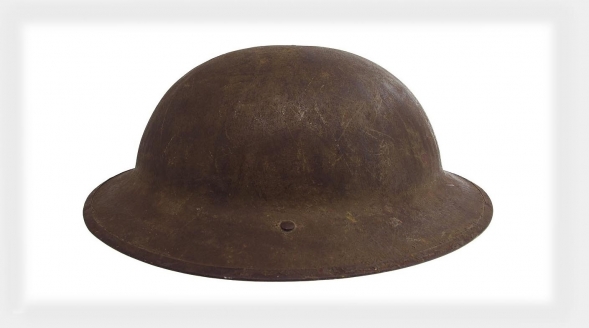
Unlike those Poilu who rushed manfully to the recruiting stations in 1914 expecting some sartorial glory in the form of a shiny cavalry breast plate or stylish bright red pantaloons, only to find that the constraints of modern warfare would only provide him with a filthy rat-infested trench and a poor-man’s concept of a camouflage uniform (light-blue wool); the American Doughboy at least had some time to figure out that he would not be as nicely turned out as his uncle was during the Spanish-American War.
This odd notice was printed on the front page of The Stars and Stripes while most of the A.E.F. was still in training. The word was out by this time that the Campaign Hats they were issued back home were out -and so to counter the gripes, the army printed this balderdash to put a ‘nice spin’ on the tin pot
It’s not a helmet
To read more about the old campaign hats of the A.E.F. click here.
In 1949 there still existed such hope and optimism for the future of the United Nations as a force for good in the world – and a profound disappointment can clearly be sensed in this writer’s voice as you read this column that reported as to how the Soviets were manipulating the organization to benefit their espionage efforts.
CLICK HERE to read about the beautiful Blonde Battalions who spied for the Nazis…
Click here to read about the blackmail and extortion tactics that American Communists used in Hollywood during the Great Depression…

Many Americans do not realize that Soviet Russia has an elected congress. As its powers are set forth in the present Russian constitution, this congress has the appearance of being both representative and democratic… ‘The Supreme Soviet’ is somewhat similar to that of our national legislature. It has two chambers, like our house and senate. The author points out that regardless of the appearances, we all know that there is a catch somewhere’.
Click here to read about the blackmail and extortion tactics that American Communists used in Hollywood during the Great Depression…