Author name: editor

Interviews: 1912 - 1960

Ronald Reagan and Jane Wyman Divorce
(Photoplay Magazine, 1948)

Attached is an article from a 1948 PHOTOPLAY MAGAZINE that illustrated quite clearly how much easier Ronald Reagan, the 40th President of the United States, had it with the Soviet Union, when compared to his failings with his first bride, Jane Wyman (1917 – 2007). The journalist, Gladys Hall, outlined nicely how busy the couple had been up to that time yet remarked that they had had a difficult time since the war ended, breaking-up and reconciling as many as three times. In 1948 Wyman, who had been married twice before, filed for divorce on charges of mental cruelty; the divorce was finalized in ’49 and the future president went on to meet Nancy Davis in 1951 (marrying in ’52); click here if you wish to read a 1951 article about that courtship.


Historically, Ronald Reagan was the first divorced man to ascend the office of the presidency. Shortly after his death, Wyman remarked:

America has lost a great president and a great, kind, and gentle man.


Click here to read about the Cold War prophet who believed that Kennan’s containment policy was not tough enough on the Soviets…


Click here read an article about Hollywood’s war on monogamy.

Advertisement

Mother of the Year: Joan Crawford (Photoplay Magazine, 1948)
1948, Hollywood History, Photoplay Magazine, Recent Articles

Mother of the Year: Joan Crawford
(Photoplay Magazine, 1948)

This article, I’m an Adopted Mother, by Hollywood movie actress Joan Crawford (1905 – 1977) rambles on column after column about her four adopted children and the tremendous fulfillment they brought to her life. It was all a bunch of hooey, and we might have ended up believing it all, if it weren’t for her daughter Christine, who, in 1978, published a bestselling memoir testifying to the beatings that the movie star could be depended upon to deliver regularly; a first edition of the book is available at Amazon – it was titled Mommy Deareststyle=border:none

Two Who Escaped the Germans (Yank Magazine, 1945)
1945, POWs, Recent Articles, Yank Magazine

Two Who Escaped the Germans
(Yank Magazine, 1945)

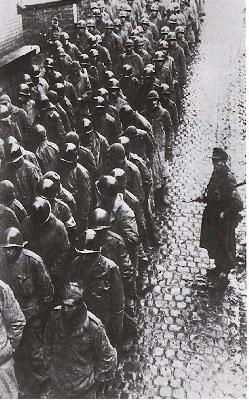
Remarkable for lacking bravado and deeds of cunning daring-do, this is a war story about two hapless GIs of the 84th Division who got themselves captured and, do to a heavy U.S. artillery barrage (that served as a backdrop throughout much of the story), were able to escape and allude further incarceration. The German officers who (briefly) lorded over these men are beautifully painted as dunderheads that will surely amuse. Wandering in a southerly direction through the frost of Belgium, they make it back to their outfits in time for a New Year’s Day supper.

Click here if you would like to read about a World War One German P.O.W. camp.

Advertisement

Miscellaneous

Sheep from the Sky
(Click Magazine, 1938)

One of the weirdest inventions found in the annals of Italian military history was reserved for sheep. The funny pictures attached herein were snapped during the Italian adventures in Ethiopia, when sheep parachuting from the sky was not thought of as anything unusual and the story goes that the far-flung Italian infantry simply could not bare to have the standard pre-packaged processed food that most armies have to suffer and so an accommodating military air-dropped do-it-tour-self Ossobuco kits.

Advertisement

The Abusive Occupying Army (Collier's Magazine, 1946)
1946, Aftermath (WWII), Collier's Magazine, Recent Articles

The Abusive Occupying Army
(Collier’s Magazine, 1946)

This editorial lends credibility to Andrei Cherny’s 2007 tome, The Candy Bombersstyle=border:none, in which the author states that there was no love lost between the Berliners and the occupying American army in the immediate aftermath of the German surrender:

Stories keep coming back to this country about American soldiers sticking up Berlin restaurants, or beating up German citizens, or looting German homes. How much of this stuff goes on, we don’t know. We do know that some of it goes on, and that any of it is too much. Not that we believe in sobbing unduly over the German people, they let themselves be razzle-dazzled into the war by Hitler and his mobsters.

The Battle at the Great Wall (Literary Digest, 1933)
1933, Recent Articles, Sino-Japanese Wars, The Literary Digest

The Battle at the Great Wall
(Literary Digest, 1933)

…Peiping Associated Press dispatches tell of a major battle between Japanese and Chinese armies for possession of Chiumenkow Pass in the Great Wall of China. The Pass is one of the most important gateways leading into the rich province of Jehol which, it is reported, Japan purposes to cut off from China and add to Manchukuo…This collision forms the second chapter in the Shanhaikwan dispute, and it comes quickly.

Advertisement

The Red Spies in Washington (Coronet Magazine, 1952)
1952, Coronet Magazine, Recent Articles, Spies

The Red Spies in Washington
(Coronet Magazine, 1952)

Stalin’s deep fear of traitors and moles was not simply confined to the Soviet Union – it spread throughout every branch of his embassies as well. This article pertains to the Soviet spies who worked in Washington – the ones who spied on the Soviet diplomatic corps:

When a new [diplomat arrives from Moscow] he soon learns that the Ambassador is not the real boss. One outside diplomat who has contacts with the Embassy declares: ‘Always, there is someone in the Embassy whom the others fear. They live in terror of him, for he is the real leader… I have seen Soviet officials actually tremble when he comes into the room.’


A 1951 article about the young CIA can be read by clicking here…

Advertisement

Nesei Homecoming (Yank, 1945)
1945, Japanese-American Service, Yank Magazine

Nesei Homecoming
(Yank, 1945)

Who knows, perhaps the author of Bad Day at Black Rockstyle=border:none, Howard Breslin, had read this striking bit of fiction from YANK MAGAZINE and felt such a deep sense of social injustice that it inspired him to write his novel about anti-Isei mob violence. Either way, this very moving, two column piece is a fictional account about the pathetic homecoming experienced by a member of the Nesei packed 442nd Regimental Combat Team.

It was written by YANK MAGAZINE’s Len Zinberg (1911-1968; a.k.a. Ed Lacy, a.k.a. Steve April); by that time, Zinberg was already an experienced writer with impressive credits and the magazine was lucky to have him. His writings at YANK helped to open the door at THE NEW YORKER, where much of his work was to be seen following the end of hostilities.

'Loyal Japanese Fight for the U.S.A.'' (Click Magazine, 1943)
1943, Click Magazine, Japanese-American Service

‘Loyal Japanese Fight for the U.S.A.”
(Click Magazine, 1943)

This photo essay from CLICK MAGAZINE consists of six black and white images illustrating the Nisei officers and GIs toiling under the merciless sun at Camp Shelby, Mississippi prior to being shipped out for combat duty in Italy. The accompanying paragraph sums up quite nicely their devotion to the United States, declaring that for these Japanese-Americans, democracy outweighs blood ties, yet says not a word about the internment camps.


CLICK HERE to read about the beautiful Blonde Battalions who spied for the Nazis…

Advertisement

Scroll to Top