Author name: editor

Robert Henri (Vanity Fair, 1916)
1916, Modern Art, Recent Articles, Vanity Fair Magazine

Robert Henri
(Vanity Fair, 1916)

A VANITY FAIR MAGAZINE profile of the American painter Robert Henri (1865 – 1929):

Robert Henri does not sympathize with the artists who throw their work in the face of the public with a ‘There, take it or leave it.’ Indeed, he has an almost hieratic belief in the power of the fine arts, not merely to delight, but to improve, to uplift and to educate the masses.

Click here to read further about the 1913 Armory show.

Irwin Shaw Recalled Combat PhotographerRobert Capa ('47 Magazine, 1947)
1947, 47 Magazine, Miscellaneous

Irwin Shaw Recalled Combat PhotographerRobert Capa
(’47 Magazine, 1947)

American novelist Irwin Shaw (1913 – 1984) was quick to reminisce about the bad old days of World War II and Robert Capa (1913 – 1954), who fit it like a round peg fits a round hole:

Capa is a dangerous influence because he has perfected the trick of making life among the bombed cities and the stinking battlefields of our time seem gay and dashing and glamorous…


Click here to read an anecdote about Robert Capa during the Spanish Civil War.

Advertisement

Use shortcode [oma_ad position="summary_top"] (or other position) in your theme or widgets to display OMA Promotions here.

William Orpen and the Portrait of Mrs. Oscar Lewisohn (Vanity Fair, 1915)
1915, Modern Art, Recent Articles, Vanity Fair Magazine

William Orpen and the Portrait of Mrs. Oscar Lewisohn
(Vanity Fair, 1915)

Here is a petite notice that appeared in a 1915 issue of VANITY FAIR heralding a new portrait by the British painter William Orpen (1878 – 1931), which depicted the likeness of a popular American stage actress Mrs. Oscar Lewisohn (Edna May Pettie 1878 – 1948). The anonymous reviewer compared the portrait styles of Orpen with that of London’s reigning portrait painter, John Singer Sargent:

Sargent had a way of showing his sitters as they didn’t think they looked. On the other hand, Orpen has a trick of making his sitters look like what they would like to be.

Four Photgraphs of the Extended Royal Family (Vanity Fair, 1915)
1915, European Royalty, Vanity Fair Magazine

Four Photgraphs of the Extended Royal Family
(Vanity Fair, 1915)

Assorted photographs of the assembled German, Spanish, Belgian, Russian, Norwegian and British royal families, posed as they gathered to attend the the 1894 and 1896 Royal weddings at Coburg; also pictured is the group photo snapped at the 1898 shooting party at Sandingham. Queen Victoria appears in two of the pictures, while Kaiser Wilhelm II can be seen in all of them.

Advertisement

Use shortcode [oma_ad position="summary_top"] (or other position) in your theme or widgets to display OMA Promotions here.

Clothing the Camper and Yachtsman (Vanity Fair Magazine, 1917)
1917, Men's Fashion, Vanity Fair Magazine

Clothing the Camper and Yachtsman
(Vanity Fair Magazine, 1917)

For all too few it is understood that fashion need not end in the wilderness: for it is more than likely that that was where the need for fashion was first recognized and it was there, among the toads and the dung, that the Well-Dressed man first crawled out of the muck and civilizationstyle=border:none

was born. With all this in mind, Robert Lloyd Trevor reviewed the fashions for the enjoyment of camp-life in this 1917 Vanity Fair review. Another vital concern touched upon by the journalist was the clothing available to the yachtsmen at that time:
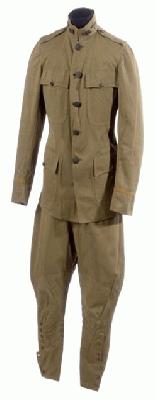
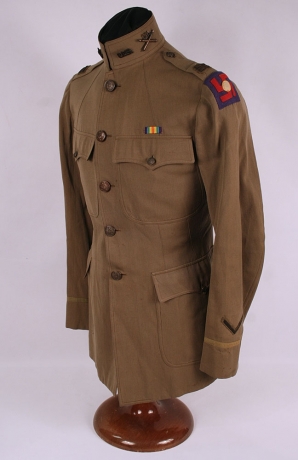
Yachting is one of the things that begin at the bottom. That is to say, at the shoes. They are the foundation, as it were, for the rest of life on the rolling deep.

The Fifth Avenue Soldier (Advertisement, 1918)
1918, U.S. Army Uniforms of World War One

The Fifth Avenue Soldier
(Advertisement, 1918)

The haberdashers of the Franklin Simon Company of Fifth Avenue, New York City, simply must not have been reading the many news reports regarding the horrors of industrial warfare. Indeed, their concept of coping with such carnage involved offering such sale items as silk handkerchiefs, cashmere socks and a dashing bathrobe for tooling around the barracks.

Click here to see what Brooks Brothers was selling During World War One.

Advertisement

Use shortcode [oma_ad position="summary_top"] (or other position) in your theme or widgets to display OMA Promotions here.

The Well-Born Officer (Vanity Fair, 1918)
1918, U.S. Army Uniforms of World War One, Vanity Fair Magazine

The Well-Born Officer
(Vanity Fair, 1918)

For it’s October issue, the editors of VANITY FAIR magazine stepped up to the plate and did their bit with this splendid review of all the finest uniform apparel that New York City offered it’s silk stocking officers. The article is nicely illustrated with photographs of a double-breasted mackinaw coat, two officer blouses (one of a wool-silk blend), a classic silk knit service tie as well as a very fine trench boot.


New From Amazon: Doughboys on the Great War:
How American Soldiers Viewed Their Military Experience
style=border:none

1922, Confederate Veteran Magazine, Miscellaneous

Civil War Reunion Clothing
(Confederate Veteran Magazine, 1922)

What did the smart, re-constructed Confederate soldier wear to the reunions, you ask? Why an eight buttoned sack coat with matching trousers composed of Dixie Gray wool, of course! It was all the rage among the apple-sauce crowd of 1922 – and by clicking the link below you will see a black and white ad from Confederate Veteran Magazine which pictured the togs.

Advertisement

Use shortcode [oma_ad position="summary_top"] (or other position) in your theme or widgets to display OMA Promotions here.

Paul Thevenaz: Rhythmatist Painter (Vanity Fair, 1916)
1916, Modern Art, Recent Articles, Vanity Fair Magazine

Paul Thevenaz: Rhythmatist Painter
(Vanity Fair, 1916)

A one page article regarding Swiss-born painter Paul Thevenazstyle=border:none (1891 – 1921) and his thoughts on the relationship between dance and modern painting. The article is accompanied by four of his portraits; the sitters were Jean Cocteau, Igor Stravinsky, the Comtesse E. De Beaumont and Comtesse Mathieu De Noailles.The profile was written by the novelist Marie Louise Van Saanen.
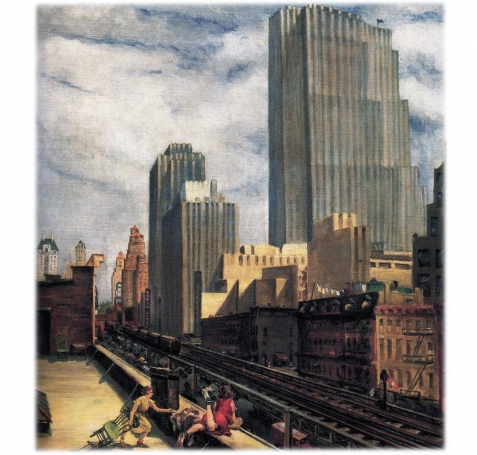
Read a 1937 article about another gay artist: Paul Cadmus.

Advertisement

Use shortcode [oma_ad position="summary_top"] (or other position) in your theme or widgets to display OMA Promotions here.

1912, Cars, Current Literature Magazine, Recent Articles

Advance of the Low-Priced Automobile
(Current Literature, 1912)

In answer to the cry for more affordable cars that can easily be purchased by working families, the French automobile industry of 1912 produced a line of long, narrow, boat-like cars, mounted on four wire wheels, carrying it’s passengers in tandem fashion. The production of these one and two cylinder air-cooled motors was based more upon the production lines of motorcycles rather than cars.

A Census of Skyscrapers (Literary Digest, 1929)
1929, Old New York History, Recent Articles, The Literary Digest

A Census of Skyscrapers
(Literary Digest, 1929)

Egged on by the 1929 completion of the Chrysler building, the curious souls who ran the New York offices of THE LITERARY DIGEST were moved to learn more about skyscrapers, both in New York as well as other parts of the U.S. and We were surprised to learn that as of 1929

50 percent of the buildings in New York from 10 to 20 stories and 60 percent of those over 20 stories are located between 14th and 59th streets.


This article also presents statistical data concerning the number of tall buildings that could be found throughout the 1920s United States.

Advertisement

Use shortcode [oma_ad position="summary_top"] (or other position) in your theme or widgets to display OMA Promotions here.

Scroll to Top