

Noel Field: Family of Spies
(People Today Magazine, 1950)
Additional magazine and newspaper articles about Cold War spies can be read on this page.Read more …

Additional magazine and newspaper articles about Cold War spies can be read on this page.Read more …

Art alone survives the earthquake shocks of revolution, and Russian art has been doubly secure because of it’s deep-rooted imagination and it’s passionate sincerity.
That was the word from Oliver M. Sayler writing from Moscow as it starved during the Summer of 1919. Sayler, known primarily for his writings on Russian theater from this period, wrote enthusiastically about the Russian Suprematist Casimir Malyevitch, Futurist David Burliuk and The Jack of Diamonds Group; believing deeply in the Russian Revolution, he wrote not a word about how the Soviets mistreated the modern artists of Russia.

To listen to Paul Meltsner one would think that it was fun to be a painter. Looking at his pictures one is compelled to conclude that life is a grim business of industrial strife, with factories shut down or picketed…
A wise-cracker and a wit at the cafe table, Mr. Meltsner is a proletarian artist when he works, and he works hard, he says. Which is what a proletarian artist should do… He exhibits frequently. He sells lithographs when he isn’t selling paintings and is represented in a number of museum collections.
Click here to read a Paul Meltsner review from ART DIGEST.

The artist Paul R. Meltsner (1905 – 1966) was one of many WPA artists given to depicting sweaty, mal-nourished proletarians laboring in the fore-ground of smoke-plagued, industrial cityscapes and his work can be found today in the vaults of every major American museum. This is a 1936 art review covering his one-man show at the Midtown Galleries in New York:
Meltsner builds his pictures everyday scenes of industrial life, dedicating them to labor and the machine…He gets broad vitality in his forms and force in his compositions, relieving at the same time the usual drabness of such scenes by a tonic of color.
Another 1936 article about Paul Meltsner can be read here.

Attached is one of the first articles to be written about balletomanes Lincoln Kirstein (1907 – 1996) and his efforts with George Balanchine (1904 – 1983) and philanthropist Edward M.M. Warburg (1910 – 1992) to form the first American ballet company (the corps was later called the New York City Ballet).

The difficult task of wandering the war-torn countryside of Europe in search of fallen World War I American pilots fell to a U.S. Army captain named E.W. Zinn. A combat pilot himself, Zinn had roamed France, Belgium and Germany interviewing the local population to see what they knew of American crash sites:
Many times he has come upon a grave with a rude cross on which was scrawled:
‘Unidentified American Aviator’ or ‘Two Unidentified American Aviators’
Captain Zinn has found that in a great many cases American fliers were buried either by the Germans or by civilians with no mark of identification left on them.
Click here to read some statistical data about the American Doughboys of the First World War.

The attached W.W. II magazine article tells the story of the hard-charging Goums – a detachment of French-Moroccan infantry who appeared to the American GIs as genuine curios (Wikipedia definition: Goumier is a term used for Moroccan soldiers, who served in auxiliary units attached to the French Army, between 1908 and 1956).
The Germans definitely don’t like the Goums. As for the Italians, they’re scared to death of them. In the Mateur and Bizerte sectors, where the Goums were attached to the Ninth Division, three Italian companies surrendered en masse as soon as they heard that the guys in front of them were Goums.

Instructions as to how American insignia was to be worn on the trench coat as well as the officer’s raincoat. An additional notice can be read concerning the Army’s wish that all Doughboys maintain a good, soldierly appearance while not serving in the zone of advance.

In Honolulu, where the war began for the U.S., the first news of it’s ending reached a sleepy-eyed Chinese-American radio technician shortly after 1200 hours (12:00 a.m.) when he had just finished making his regular weekly check on KGU’s station transmitter and was ready to leave for home.
Stand by for important news about the Potsdam ultimatum.
Flight nurse, WACs and GIs all streamed from their barracks and joined the howling procession…

Some of the highlights: Firecrackers, hoarded in Chinatown for eight years, rattled like machine guns… Servicemen and civilians played tug-of-war with fire hoses… Market Street, the wide bar-lined thoroughfare that has long been the center of interest for visiting GIs and sailors, was littered with the wreckage of smashed War Bond booths … A plump redhead danced naked on the base of the city’s Native Sons monument after servicemen had torn her clothes off. A sailor lent the woman a coat, and the pair disappeared.

In light of the overwhelming hostility toward Germans, whether they come to Paris to sign a peace treaty or for other reasons, the Parisian Gendarmes thought it best to enclose their hotel with palisade-style fencing, which they hoped would serve the dual purpose of keeping them in as much as it would serve to keep hostile natives out.
A photo of the barricade illustrates the article.
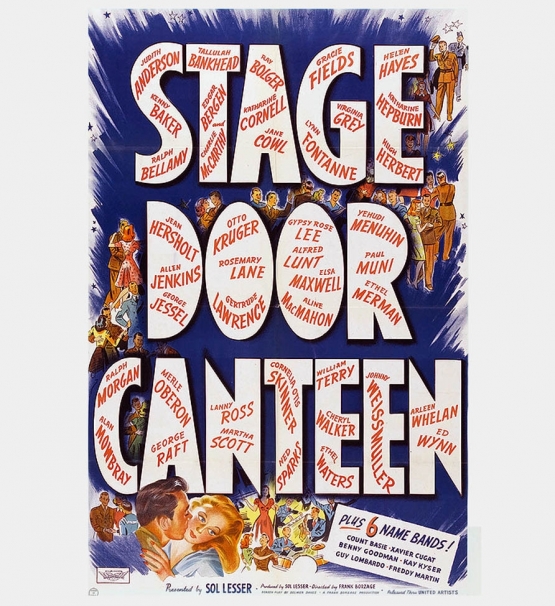
During the Second World War there were two prominent canteens where the Allied soldiers, sailors, airmen and Marines could go to see and be seen with the glamorous actor types of their day: the Hollywood Canteen in Los Angeles and the Stage Door Canteen in New York City. It was in these two locales that the stars of both stage and screen could be found both waiting and busing tables, preparing food and cracking wise with the volunteers and draftees of the Allied Armies. We needn’t tell you which of these two establishments Hollywood decided to celebrate on celluloid, but you should know that the film was extremely popular- attached is the review as it appeared in fashion magazine of the time.

Two paragraphs from THE STARS AND STRIPES explained the legal status extended to all those demobilized Doughboys who wore the highly coveted discharge chevron. The red wool chevron was worn (point down) on the left arm.
This is a three page article concerning the city of New York from Yank’s on-going series, Home Towns in Wartime. The Yank correspondent, Sanderson Vanderbilt, characterized Gotham as being overcrowded (in 1945 the population was believed to be 1,902,000; as opposed to the number today: 8,143,197) and I’m sure we can all assume that today’s New Yorkers tend to feel that their fore-bearers did not know the meaning of the word.
New York was the home base of Yank Magazine and this article presents a young man’s view of that town and the differences that he can recall when he remembers it’s pre-war glory (Sanderson tended to feel that the city looked a bit down-at-the-heel).
Click here if you would like to read an article about the celebrations in New York the day World War Two ended.

This Cold War article about the American Communist Party (CPUSA), penned in 1950 by F.B.I. Director J. Edgar Hoover (1895 – 1972) was published for two reasons:
• To alert the readers that such subversive groups exist and that they are operated by their fellow Americans who take orders from Joseph Stalin –
• and that the F.B.I. is on the job and has thoroughly infiltrated their ranks and watches them very closely.
The column is a good read for all of you out there who enjoy the cloak and dagger type of plot lines; I was surprised to learn that this group had so many secrets to hide – seeing that their problems in the arena of public relations at that time were so overwhelming, one has to wonder how they were actually able to tend to their assignments in espionage, sabotage, propaganda and all other assorted shenanigans Moscow expected of them.
Click here to read about the man who spied on the the American Communist Party.
Click here if you would like to read what the CPUSA was up to during the Great Depression.

The big question for the United States is how long American troops are to occupy Japan. The Potsdam Declaration says that the occupying forces of the Allies shall be withdrawn from Japan as soon as the objectives outlined are accomplished and ‘there has been established in accordance with the Japanese people a peacefully inclined and responsible government.’
U.S. officials appear to be thinking in terms of an occupation of only 5 or 10 years. Japanese officials, however, in looking ahead to a resurgence of Japanese power, appear to be thinking in terms of 50 to 100 years.
Read about the German POWs who were schooled in virtues of democracy.
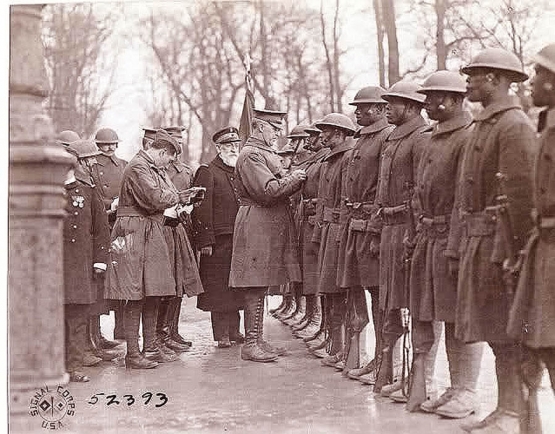
A post-Armistice Day feature article that reported on the war-time activities of the four infantry regiments that made up the U.S. Ninety-Third Division (the 369th, 370th, 371st and the 372nd).
Two of these regiments were awarded the coveted Croix de Guerre. Accompanying this history is a black and white illustration of the Division’s insignia.
A post-Armistice Day feature article that reported on the war-time activities of the four infantry regiments that made up the U.S. Ninety-Third Division (the 369th, 370th, 371st and the 372nd).
Two of these regiments were awarded the coveted Croix de Guerre. Accompanying this history is a black and white illustration of the Division’s insignia.