Author name: editor

Home Front Ditties (Yank Magazine, 1945)
1945, Home Front, Recent Articles, Yank Magazine

Home Front Ditties
(Yank Magazine, 1945)

Attached is a 1945 article written for the many homesick GIs who wondered what musical treats they were missing in their absence. All the great performers are cataloged as well as a list of many of the most popular home front hits from the top forty.

Popular music back home hasn’t changed much. The same familiar bands play the new hit tunes.

Would you like to read a 1941 article about Boogie-Woogie?

Advertisement

Paris Fashion: Summer, 1916 (Vanity Fair Magazine, 1916)
1916, Fashion, Recent Articles, Vanity Fair Magazine

Paris Fashion: Summer, 1916
(Vanity Fair Magazine, 1916)

Paying no mind to the continuing unpleasantness that was taking place somewhere around the Somme (ie. W.W. I), the taste-makers of Paris soldiered-on and created garments for mid-summer that were original and feminine and bore the mark of Paris’ characteristic opulence.


Legendary fashion designer Christian Dior had a good deal of trouble with people who would illegally copy his designs; click here to read about that part of fashion history.

Signal Corps Movie Men of W.W. I (The Stars and Stripes, 1918)
1918, Stars and Stripes Archive, The Stars and Stripes

Signal Corps Movie Men of W.W. I
(The Stars and Stripes, 1918)

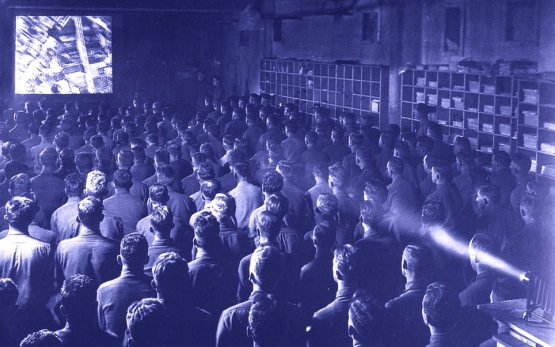
Appearing in The Stars and Stripes in mid-February of 1918 was this column about one of the newest disciplines to be introduced to the photographic section of the U.S. Army Signal Corps: the motion picture branch.

There is one movie-officer at present assigned to every division in the A.E.F.; one might call him the camera battery, if one wanted to get really military about it. Under him is a squad of expert photographers, some movie men, some ‘still’ snappers.

From the time when the sun finally decides that he might as well hobble up in the sky and do part of a day’s work, which isn’t often in this region, until the time that the aged, decrepit old solar luminary decides again, about the middle of the afternoon, that he’s done all he’s going to do while the calender is fixed the way it is, the camera battery is up and around taking pot-shots at everything in sight… They may be ‘covering’ a review, a series of field maneuvers ‘up front’ or merely Blank Company’s wash day at the village fountain. But always when the sun is shining, they are at it.


Click here to read a YANK MAGAZINE article about the Signal Corps films in the Second World War

1919, Prisoners of War, The U.S. Army Study

Americans Made Bad Prisoners
(U.S. Army Archive, 1919)

Immediately after the war General Pershing put the boys in the Army Intelligence Section to work compiling hundreds of pages worth of information concerning what the German Army thought of their American counterparts. It was concluded that, by enlarge, the Germans were afraid of the Doughboys – seeing them as recklessly brave, and unpredictably aggressive – provided with all the food they could want and kitted out with sensible and efficient equipment, the Germans begrudgingly learned not to underestimate their pugnacious enemies from across the sea.


However, the Germans learned just as quickly not to overestimate the American soldier when he was a prisoner of war: the Doughboys were believed to have been defiant, ill-mannered, cheeky and when required to work or salute German officers they would simply refuse.


The report was declassified in 1990.


Click here to read an article about the sexually-transmitted diseases among the American Army of W.W. I…

Advertisement

1945 Pétain newspaper article
1945, France, Maptalk

Pétain: ”Life in Prison”
(Maptalk, 1945)

The man who saved France in 1916 was condemned to die for nearly destroying France at Vichy in 1940, but his sentence was commuted to life imprisonment by General Charles de Gaulle.

Pétain was the twelfth marshal of France to be condemned by a French court since 1440. Eight of them were executed.

American Trench Periscopes (America's Munitions, 1919)
1919, America's Munitions, Inventions and Weapons, Recent Articles

American Trench Periscopes
(America’s Munitions, 1919)

The U.S Army only ordered two types of trench periscopes during the war. The first kind was a simple wooden box, painted a lovely shade of olive drab and measuring two inches square and 15 inches in length with two inclined mirrors set at both ends (pictured). This type was manufactured by two companies and well over 100,000 were produced.


The second variety was a mirror that was designed to fixed to the end of a bayonet, a total of 100,000 of these were delivered before the end of July, 1918 and 50,000 additional ones before November.

(Until we get the title link fixed, you can read the article by clicking here.)

Allied Aerial Reconnaissance During World War I (Vanity Fair, 1918)
1918, Inventions and Weapons, Recent Articles, Vanity Fair Magazine

Allied Aerial Reconnaissance During World War I
(Vanity Fair, 1918)

This article,Photography’s Notable Part in the War was written by an active participant in the aerial reconnaissance arm of the Royal Flying Corps, Captain Henry A. Wildon. He reported that both sides in the conflict recognized early on that intelligence gathering by way of camera and aircraft was a real possibility:

Our first airplanes in France were not supplied with photographic equipment. It was not until the beginning of 1915 that the importance of of photography became apparent, and was made possible by improvements in the type and general stability of the airplane.

Advertisement

A British Shrapnel Grenade (Trench Warfare, 1917)
1917, Inventions and Weapons, Trench Warfare

A British Shrapnel Grenade
(Trench Warfare, 1917)

During the earliest days of the war the British and Empire armies were seldom issued grenades, but the need for such weaponry became apparent once it was clear to all that trench warfare was going to be the norm. The earliest grenades (improvised by both sides) were simply food tins that were jam-packed with an explosive mixed with nails, glass shards and bits of iron. By 1915 grenade production was in full swing and British historians have estimated that throughout the course of the war on the Western Front, British and Commonwealth forces had used fifteen million hand-grenades.

The following article concern a British shrapnel grenade that is of the heavy friction pattern.

An Early Gas Mask (Magazine Ad, 1915)
1915, Inventions and Weapons, Magazine Advertisement, Recent Articles

An Early Gas Mask
(Magazine Ad, 1915)

At the time when the Entente powers were first exposed to poisonous gas in the spring of 1915, their respective quartermasters scrambled to secure suitable antidotes and precautionary measures that would save the men in the front line trenches. One of the earliest improvisations was a gauze face mask that covered both mouth and nose, drenched in urine. The attached commercial illustration is from the margins of the French news magazine, L’ILLUSTRATION which depicts one of these earlier attempts.


Click here to see an illustration of the German gas shells.


Clicke here to read more articles about W.W. I gas warfare.

Recent Articles, World War One

A Drawing of a German Trench Latrine
(Royal Engineers, 1915)

Attached, you will find a mechanical drawing made by the industrious souls assigned to the Royal Engineers in order to placate those busy-body brass-hats situated so far in the rear and having little better to do than wonder aloud as to how the Hun tended to deal with his bowel movements.

The author of
The Western Front Companionstyle=border:none is very informative on the topic of trench latrines and tells us that as the war progressed, latrines evolved into loitering centers for those wishing to read or enjoy some solitude. In order to remedy the situation officers decided to position their front-line trench latrines at the end of short saps, closer to the enemy; the reason being that a man was less likely to tarry and would return to duty that much quicker.

Advertisement

Carl Sandburg at 70 ('48 Magazine)
48 Magazine, Recent Articles, Twentieth Century Writers

Carl Sandburg at 70
(’48 Magazine)

Here is a salute to the poet Carl Sandburg (1878 – 1967) written by Louis Untermeyer (1885 – 1977) marking the occasion of Sandburg’s biography of Abraham Lincoln:

At 70 Sandburg is the voice of the common man, and it is only natural that his biography of Abraham Lincoln should express for all time the spirit of that uncommon man who was the common denominator of humanity.

President Roosevelt and the Panay Incident (Literary Digest, 1937)
1930s Military Buildup, 1937, Recent Articles, The Literary Digest

President Roosevelt and the Panay Incident
(Literary Digest, 1937)

Attached, you will find a survey of opinions drawn from diverse corners of the fruited plain regarding the restraint exercised by President Franklin Roosevelt in the wake of Imperial Japan’s sinking of the U.S. gunboat Panay:

[President Franklin Roosevelt] should be sustained in his effort to make Japan realize that she cannot continue a policy of aggression with disregard of treaties and international law. A firm policy now for law and order will save many lives.

-Russell J. Clinchy,Washington Council for International Relations

Germany's Lost African Colonies (Ken Magazine, 1938)
1930s Military Buildup, 1938, Ken Magazine

Germany’s Lost African Colonies
(Ken Magazine, 1938)

One thing about Adolf Hitler: he had a real bee in his bonnet when it came to the colonies that Imperial Germany had lost as a result of article 119 of the Versailles Treaty:

Germany renounces in favor of the principal Allied and Associated Powers all her rights and titles over her overseas possessions.

Attached, you will find a nifty cartoon depicting a terribly upset Hitler as he contemplated the map of Africa and all the colonies he was having to do without – all rendered in that glorious 1930s manner.

Click here to read more about the African colonies lost to Germany as a result of the Versailles Treaty.

Advertisement

The Dial Diet of 1955
1955, Diets of Yore, Pageant Magazine

The Dial Diet of 1955

Within the cozy confines of the attached PDF file rest in honored glory the digital reproduction of seven (7) tried-and-true diets from 1955:


• The Liquid Diet


• The Spring Cleaning Diet


• The du Pont Diet

• The Basic Seven Diet


• The Famous Clinic Diet


• The Hard and Fast Diet


• The Daily Dozen Diet


They were all the necessary diet choices required for the (so-called) Pageant Diet Selector Dial, which is a part of the download. Seeing that there is not a single diet that is right for everyone, there is attached herein a paper dial that can be referred to daily – one for women and the other for men:

Looka at the outside band of the wheel for your age and activity group (whether you lead an active or a sedentary life). Then, select the number of pounds you want to loose.


– finally select the diet or combination of diets, indicated by the number on the inner wheel and follow the directions.


From Amazon:


The Doctor’s Diet: Dr. Travis Stork’s STAT Program to Help You Lose Weight & Restore Your Healthstyle=border:none

The Fad for Felt Fashion (Quick Magazine, 1951)
1950s Fashion, 1951, Quick Magazine

The Fad for Felt Fashion
(Quick Magazine, 1951)

The fad for skirts fashioned out of felt began with college girls when it was discovered that a flattering silhouette could be achieved when the fabric was cut on the bias; the attached article shows the color image of a felt ballet skirt as a case in point.


Sub-standard fabrics play a part in fashion’s march from time to time; in the Sixties there was a short-lived craze in some circles to wear dresses made from paper or vinyl.

Advertisement

Scroll to Top