Author name: editor

The Well-Born Officer (Vanity Fair, 1918)
1918, U.S. Army Uniforms of World War One, Vanity Fair Magazine

The Well-Born Officer
(Vanity Fair, 1918)

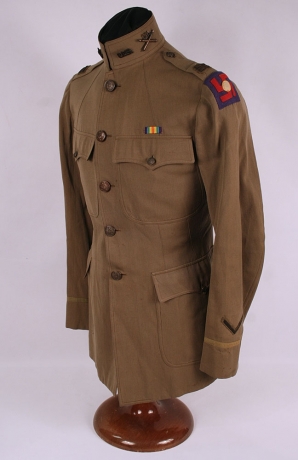
For it’s October issue, the editors of VANITY FAIR magazine stepped up to the plate and did their bit with this splendid review of all the finest uniform apparel that New York City offered it’s silk stocking officers. The article is nicely illustrated with photographs of a double-breasted mackinaw coat, two officer blouses (one of a wool-silk blend), a classic silk knit service tie as well as a very fine trench boot.


New From Amazon: Doughboys on the Great War:
How American Soldiers Viewed Their Military Experience
style=border:none

1922, Confederate Veteran Magazine, Miscellaneous

Civil War Reunion Clothing
(Confederate Veteran Magazine, 1922)

What did the smart, re-constructed Confederate soldier wear to the reunions, you ask? Why an eight buttoned sack coat with matching trousers composed of Dixie Gray wool, of course! It was all the rage among the apple-sauce crowd of 1922 – and by clicking the link below you will see a black and white ad from Confederate Veteran Magazine which pictured the togs.

Advertisement

Paul Thevenaz: Rhythmatist Painter (Vanity Fair, 1916)
1916, Modern Art, Recent Articles, Vanity Fair Magazine

Paul Thevenaz: Rhythmatist Painter
(Vanity Fair, 1916)

A one page article regarding Swiss-born painter Paul Thevenazstyle=border:none (1891 – 1921) and his thoughts on the relationship between dance and modern painting. The article is accompanied by four of his portraits; the sitters were Jean Cocteau, Igor Stravinsky, the Comtesse E. De Beaumont and Comtesse Mathieu De Noailles.The profile was written by the novelist Marie Louise Van Saanen.
Read a 1937 article about another gay artist: Paul Cadmus.

Advertisement

1912, Cars, Current Literature Magazine, Recent Articles

Advance of the Low-Priced Automobile
(Current Literature, 1912)

In answer to the cry for more affordable cars that can easily be purchased by working families, the French automobile industry of 1912 produced a line of long, narrow, boat-like cars, mounted on four wire wheels, carrying it’s passengers in tandem fashion. The production of these one and two cylinder air-cooled motors was based more upon the production lines of motorcycles rather than cars.

A Census of Skyscrapers (Literary Digest, 1929)
1929, Old New York History, Recent Articles, The Literary Digest

A Census of Skyscrapers
(Literary Digest, 1929)

Egged on by the 1929 completion of the Chrysler building, the curious souls who ran the New York offices of THE LITERARY DIGEST were moved to learn more about skyscrapers, both in New York as well as other parts of the U.S. and We were surprised to learn that as of 1929

50 percent of the buildings in New York from 10 to 20 stories and 60 percent of those over 20 stories are located between 14th and 59th streets.


This article also presents statistical data concerning the number of tall buildings that could be found throughout the 1920s United States.

Advertisement

1916, Fashion, Strauss Magazine

New York Fashions for Spring
(Strauss Magazine Theatre Program, 1916)

Before it was called Playbill it was called the Strauss Magazine Theatre Program and Cora Moore was their fashion critic. During the early spring of 1916 Mrs. Moore took a serious look at the fashion parade on Fifth Avenue and recognized that much of it had been seen before. She offered no thoughts as to why so much from the past was being borrowed but she liked it just fine nonetheless.

New York's Contributions to English (Holiday, 1949)
1949, Holiday Magazine, Old New York History, Recent Articles

New York’s Contributions to English
(Holiday, 1949)

New York City’s contributions to the American language go considerably further than the pronunciation of ‘avenyeh’ for avenue or ‘erl’ for lubricant. Peter Stuyvesant’s village has made rich entries into our spoken and written tongue. A handful, culled from Dr. Mitford M. Matthew’s A Dictionary of Americanismsstyle=border:none
follows.

Click here to read more articles about American English.

Advertisement

1916, Fashion, Strauss Magazine

New York Fashions for Spring
(Strauss Magazine Theatre Program, 1916)

Before it was called Playbill it was called the Strauss Magazine Theatre Program and Cora Moore was their fashion critic. During the early spring of 1916 Mrs. Moore took a serious look at the fashion parade on Fifth Avenue and recognized that much of it had been seen before. She offered no thoughts as to why so much from the past was being borrowed but she liked it just fine nonetheless.

The Pankhursts (Life Magazine, 1912)
1912, Life Magazine, Recent Articles, Women's Suffrage

The Pankhursts
(Life Magazine, 1912)

In the digital age, we are able to recognize civil disobedience and call it by name, but this was certainly not the case for this Old Boy writing in 1912; he read about the criminal past-times of Mrs. Pankhurst (Emmeline Pankhurst, 1850 – 1928) and her two daughters (Christobel Pankhurst, 1880 – 1960; Estelle Sylvia Pankhurst, 1882 – 1960), and thought that no good could possibly come of such rabble-rousing.

Advertisement

World War II in the Jungles of Burma (Yank Magazine, 1944)
1944, Recent Articles, World War Two, Yank Magazine

World War II in the Jungles of Burma
(Yank Magazine, 1944)

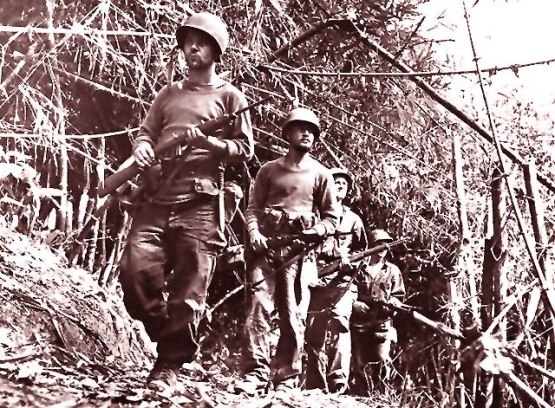
Written by correspondent Dave Richardson (1916 – 2005) behind Japanese lines in Northern Burma, this article was characterized as odds and ends from a battered diary of a footsore YANK correspondent after his first 500 miles of marching and Jap-hunting with Merrill’s Marauders.


One of the most highly decorated war correspondents of World War II, Richardson is remembered as the fearless reporter who tramped across 1,000 miles of Asian jungle in order to document the U.S. Army’s four-month campaign against entrenched Japanese forces – armed only with a camera, a typewriter and an M-1 carbine.

Advertisement

Scroll to Top