

British Officer’s Uniform Insignia
(Bovril Booklet, 1917)
Attached you will find five black and white drawings illustrating the British Army sleeve insignia worn throughout the First World War.

Attached you will find five black and white drawings illustrating the British Army sleeve insignia worn throughout the First World War.

Adorned with photos of the famous movie-monster-actor mowing his lawn and kissing his wife, this COLLIER’S MAGAZINE article tells the tale of how an English boy named William Henry Pratt became a famous Hollywood actor named Boris Karloff (1887 – 1969). This piece was originally conceived in order to promote the actor’s appearance on Broadway in the roll of Jonathan in Arsenic and Old Lace. The writer makes it quite clear to all that the show-biz career did not in any way come easily to Karloff and involved years of truck driving and traveling about performing in summer-stock theaters throughout the whole of North America before he was able to make a name for himself as a bit actor in the silent films of Hollywood.
Click here to read about the vulgar side of Erroll Flynn.

The legendary sports writer, Grantland Rice


In this letter from the artist Bernard Boutet de Monvel (1884 – 1949) the fellow explains thoroughly his thoughts and adventures as a bombardier in a Vosin bi-plane; experiences which contrast greatly with his days in the trenches and he writes well on the feelings of loneliness that an aviator can experience at 2000 feet.
For those who are interested in learning about the living conditions and daily life of World War One pilot officers this article can only help you.

Attached herein is the obituary of a remarkable woman and early feminist: Belva Lockwood (1830 – 1917) was the first woman lawyer to argue a case before the United States Supreme Court. A graduate of Genesee College, she was the nominee from the Equal Rights Party of the Pacific to run for President during the 1884 U.S. election.

Musical historian W.S.B. Mathews considers the three musical styles of Ludwig van Beethoven (1770 – 1827) and entirely dismisses the possibility that his deafness in later years effected his compositions not one jot.

KEY WORDS: Battle of Cherbourg 1944,liberation of Cherbourg 1944,Battle of Cherbourg Magazine Article 1944,cherbourg France in ww2,american troops at cherbourg

The British writer Aldous Huxley (1894 – 1963) had much praise for the artist Augustus John (1878 – 1961) and his skill as a portrait painter:
With his few fellows he stands apart, reminding us in the most salutary fashion that it is the gift of God, not the correct education, that produces genuine art…
Not long after the death of Auguste Rodin (1840 – 1917) Paris-based artist Stephen Haweis (1878 – 1969) remembered his friendship with the French sculptor:
He loved flattery, as all human beings do, and would listen attentively to rhapsodies from almost anybody, though they do say that a pretty lady got more attention from him than a half-starved journalist.
Rodin proclaimed himself the culminator of one era of sculpture, the inspirer, and nearly the author of another. He was the father of various schools which are lumped under the title of Modern Art.

The great meeting held recently in London to launch the Women’s National Anti-suffrage League was made additionally noteworthy by the participation of Mrs. Humphry Ward…
The real reason why women ought not to have the political franchise is the very simple reason that they are not men, and that according to a well-known dictum, even an act of Parliament can not make them men. Men govern the world, and, so far as it is possible to foresee, they must always govern it.
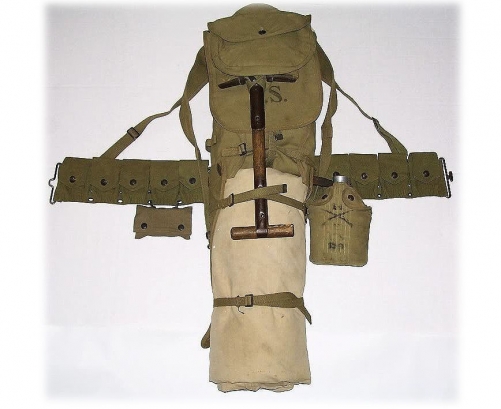
The attached article, How Our Soldiers Carry Their Ammunition, was originally published in a 1918 sporting magazine and gives an account as to how one uniform element unique to the U.S. and British military establishments came into prominence during the earliest years of the Twentieth Century. Written by Paul A Curtis, Jr., the essay describes the difficulties inherit with leather belting, the British need for an alternate material in order to maintain colonial regiments in India and the father of the American web belt, General Anson Mills (1834 – 1924).
When the Doughboys complained, they complained heavily about their uniforms; read about it here.

Some ninety-three years ago, Fish was the name scribbled on those unique cartoon illustrations that could be found throughout VOGUE (both American and British) and VANITY FAIR. The editor of American VOGUE between the years 1914 and 1952, Edna Woolman Chase (1877 – 1957) called this English cartoonist brilliant and began running her drawings from her earliest days in that office; her full name was Ann Fish and this article will tell you all we know about her.
This most cosmopolitan of living black-and-white satirists has never stirred from England in all her days. She has never especially extended herself as a spectator of the London life which she so amusingly depicts. She has never gazed on Fifth Avenue.
Attached is a 1910 article that rambles on for two columns and offers the reader nothing but nasty, vile insulting remarks regarding the character and appearance of American women. The article lays bare the low opinions conceived by an assortment of well-traveled, high-born, hot-headed-Hindus from way-down-East-India-way. AND the abuse of American women and their free press wasn’t enough for them; they had to drag American men into their tirade as well:
The women of your big, vast, young country, I confess, disappoint me…they are less chic, they are tactless, they are ignorant…I understand that some American women make the proposal of marriage. That I do not doubt after watching them make themselves ‘agreeable’ to a man at dinner. I am not surprised that American men do not make love well. The women save them the trouble.

A thumbnail history of the United States Army Ambulance Service, which first arrived in June of 1917.
All through the hard French fighting of 1917 the 6,000 American ambulance drivers kept steadily at work in every sector of the French front. It was not until March, 1918, that the first sections of the service found themselves helping in battles with the fighting regiments of their own Army.
Many of the volunteers were college men, such as the poet E.E. Cummings, who wrote an interesting account of his days as an ambulance driver during the war.

A brief account of the 1916 November elections in the United States and how well women candidates fared, particularly in the West where gains where strongest:
The continued election of women to minor offices may be taken as showing that suffrage has increased the number of those from whom fit choices can be made.
1924 was a very important year for American women in politics…
…Christianity in America is divided into two camps. The one is orthodox. It’s orthodoxy is apt to degenerate into the senile attachment to the letter of Scripture…There is a lack of mental breadth, of intellectual enlightenment, about the members of this school which is a little disheartening to one who is in agreement with them on the central matters…The other school seems to have sacrificed almost everything which makes Christianity distinct from a temporary philosophy. It’s members have the bad habit of preaching eugenics or sociology in place of the Gospel. They appear to be afraid of the great epistles and the nobler passages of the Gospels, and are apt to speak in terms which would suggest that there was nothing distinctive in Christianity which can make it an absolute and universal faith.

In his lifetime Amedeo Modigliani‘s (1884 – 1920) was only honored one time with his own solo showing in an art gallery; many of his paintings were given away in exchange for meals in restaurants and he died the death of a pauper in some unglamorous corner of Paris. In the years that followed the art world began to learn about Modigliani bit by bit through art reviews like the one attached herein. Written sixteen years after his death, this is a review of a Modigliani exhibit at the avant-garde gallery of Mrs. Cornelius J. Sullivan in New York City:
C.J. Bulliet (1883 – 1952) in ‘Apples and Madonnas’ declared that Modigliani’s nudes may be ranked ultimately with the great ones of all time – with Giorgione’s ‘Sleeping Venus’, Titian’s ‘Venus Awake’, Goya’s ‘Maja’ (nude and even more impudently clothed), with Manet’s sensational wanton in the Louvre.’
A VANITY FAIR article by Ard Choille that recalls the low key visit that Belgium’s Albert I (1875 – 1934) made to the U.S. in 1898 while in the company of his young bride, Elizabeth (1876 – 1965), formerly the Duchess of Bavaria. Published at a time when the Great War was in it’s fourth month, the journalist was mindful of the valiant roll Albert was maintaining as the Commander-in-Chief of the struggling Belgian Army in the face of the German onslaught.
Click here to read about the W.W. I efforts of Prince Edward, the future Duke of Windsor.