
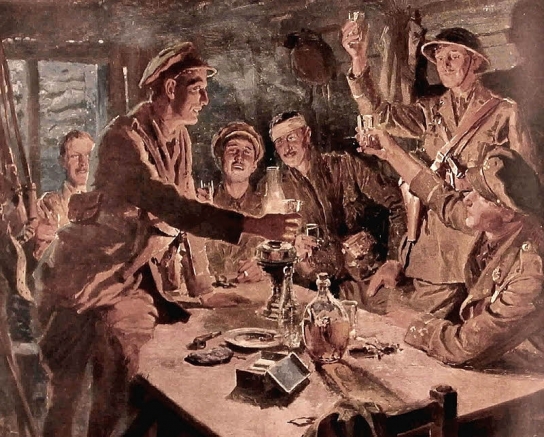
W.W. I Clip Art: British Officers
Three commercial drawings of World War One British officers pulled from three different wartime publications.
Click here to read about W.W. I art.

Three commercial drawings of World War One British officers pulled from three different wartime publications.
Click here to read about W.W. I art.

The Doughboys were grateful to be issued European spiral-puttees in place of their canvas gaiters -which did them no good whatever in the dampness of Northern Europe; however, as the attached W.W. I photographs so clearly indicate (as does this cartoon by Walgren), not many Yanks were as proficient at wrapping them as the upper brass had hoped.

1919 marked the third anniversary of the Battle of Verdun and the grounds were still littered with the dead, surrounded by a tons of equipment, lying in open fields pock-marked by thousands of high explosive shells:
Spring will come to France next month, but Spring will not come to the field of Verdun. Already the grass is green on the broad stretches of Champagne; in the Vosges the snow patches linger only in the stubborn shelter of rocks that bar the sun,; but there is no portent of resurrection in all the stretch of churned up gravel marking the line of forts that protect the citadel of the Meuse from the Northeast…the shell holes are filled with clear water, and between them course new born brooks, sublimating in crystal pools from which no man would dare drink.

Photographs of a small, hand-held helium balloon being loaded with German translations of President Wilson’s April (1917) war address in order that they might be released over the German trenches. This small notice makes clear that this particular method of persuasion resulted in fifty Germans surrendering.

An Arthur B. Davies (1862 – 1928) review written by VANITY FAIR art critic Frederick James Gregg following the opening of an exhibition highlighting the the private collection of N.E. Montross. The critic wrote:
Since the death of Albert Pinkham Ryder (1847 – 1917), Mr. Davies has been recognized, by persons abroad who are familiar with art in America, as the leading living painter on this side of the Atlantic.

This page contains a chart clearly stating the number of men who served in the U.S. Army during World War One, the number of men provided by each state and what percentage of the entire army originated from these states.
*Doughboys from New York numbered 367,864 and made up 9.7% of the U.S. Army.
*Doughboys from Pennsylvania numbered 297,891 and made up 7.93% percent.
*While the men of California made up 2.98% of the army, clocking in at 112,514.
etc…etc…etc…
Click here to read about the shipments of chewing gum that were sent to the American Army of W.W. I.

An outraged editorial writer opines that the prohibition of alcohol will serve to corrupt the morality of more Americans than it could possibly save. Additionally, the writer alludes to the fact that, at the time, the U.S. Congress was discussing the prohibition of tobacco, as well:
It is coming time to write the obituary of Joy. Less than a year ago
the Cheering Cup was removed from American life. Now we are told that just as soon as enough Congressmen can be intimidated, not a difficult job, the Soothing Weed is also to be extinguished.
The writer places blame more upon the apathetic American voter rather than the grafters in Congress.
A cartoon by C. LeRoy Baldridge (1889 – 1977) which depicted the streets of Paris in a way that only the A.E.F. could have witnessed it. A Yank-heavy Place de l’Opera is overwhelmed by sight-seeing Doughboys (note the Y.M.C.A. patch on the tour guide) and loitering officers lounging about over-priced cafes. In the foreground stands a bewildered Doughboy, dumb-struck by the passing gaze of an appreciative Parisienne while a few steps away a four-gold-chevroned private gets reamed for failing to salute the single-chevron looey. The stage is shared by bickering cabees, melancholy widows, wandering sailors, unforgiving MPs and a hard-charging, over-weight uniformed woman.
Click here to read about W.W. I art.
Click here to read the observations of U.S. Army lieutenant Louis L’Amour concerning 1946 Paris.

By the time April of 1919 rolled around, it seemed to the Doughboys who were waiting for that boat to take them back to the good ol’ U.S. of A that their French allies had a short term memory and were terribly ungrateful for American sacrifices made on their behalf. Many post-Armistice letters written by the Doughboys were filled with snide comments about the high prices they were asked to pay for everyday merchandise, prices that seemed to be chosen just for them. Wisely, the Stars and Stripes editors chose not to take sides in this debate but ran this nifty little piece about the manner in which the Americans of 1782 treated their French allies during the American Revolution.
Click here to read about the foreign-born soldiers who served in the American Army of the First World War.

A chronology of the important events that occurred during one of the most eventful years of the American Civil War: 1864.
As the year commenced, President Lincoln called for an additional 500,000 men to be drafted; General Ulysses S. Grant assumed command of the Army of the Potomac; Admiral Farragut sailed victoriously out of Mobile Bay and assorted New York hotels were set ablaze by rebel agents.

The back-and-forth that took place throughout a number of Florentine conversations between journalist Fredericka V. Blankner and Italian writer and drama theorist Luigi Pirandello (1867 – 1936: awarded Nobel Prize for Literature in 1934) were printed in her 1928 article, Pirandello, Paradox:
I see life, says Pirandello, as a tragedy…

When this Hollywood profile first appeared on paper, actress Lana Turner (1921 – 1995) was all of twenty-nine years of age and about to begin working on A Life of Her Own
it was her thirtieth movie; her last four films had nearly grossed a record-breaking $20 million, and her smiling mug was on each and every Hollywood fan magazine that could be found.
Today, the sleek, gray-eyed Lana has shed the plumpness of two years ago, keeps her weight between to 118 and 127 lbs… Now Lana is as shapely as she was in those early days. She has the ‘perfect’ figure: 5 ft. 3 in., 34-in. bust, 24-in. waist, 34.5 in. hips.
The article is illustrated with photographs from eight of her pre-’49 movies and lists all the husbands that she’d collected up to that same period (she had acquired eight husbands before she was through).
A Russian and an English Novelist… Ivan Turgenev (1818 – 1883) the Russian, ceased his activities in 1883. George Gissing (1857 – 1903), the Englishman, began his in 1882.
Three commercial illustrations of women that had originally appeared in an American clothing catalog in the year 1918.
Click here to read a collection of articles about the roll women played during W.W. I.
France has discovered Lafayette in this age only because America never forgot him
This article reports that the Marquis de Lafayette

The Mobilization for Human Needs charity campaign was the brain-child of President Roosevelt; it was based on his belief that private charities, when teamed with either county, state or the Federal government, could serve the public good better than these agencies could do when working separately.
The attached page appeared in hundreds of popular magazines during the Fall of 1933 imploring the readers to donate to the local charities that were associated with this campaign.
