Author name: editor

Ellis Island During the 1920s
1921, Immigration History, Recent Articles, The Literary Digest

‘Making the Immigrant Unwelcome”
(Literary Digest, 1921)

To read this 100-year-old article is to understand that the inhumane conditions of today’s alien detention centers on the Southwest border are a part of a larger continuum in American history. This article addressed the atrocious conditions and brutality that was the norm on Ellis Island in the Twenties.

But it is not the stupidity of the literacy test alone that is to be condemned. It is its inhumanity.

Jesus People Magazine Article | ATHANASIUS Christian Writings
1973, Faith, Jesus People Magazine, Recent Articles

When the Word Became Flesh
(Jesus People Magazine, 1973)

The Christian concept of death is contained in this article by the ancient Greek author Athanasius (296 – 373).

All those who believe in Christ tread death underfoot as nothing and prefer to die rather than to deny their faith in Christ, knowing full well that when they die, they do not perish, but live indeed, and become incorruptible through the the resurrection. Death has become like a tyrant who has become completely conquered by the legitimate monarch and bound hand and foot so that the passers-by jeer at him.

Advertisement

US Border Patrol History
1940, Collier's Magazine, Immigration History, Recent Articles

The Border Patrol
(Collier’s Magazine, 1940)

This article lays out the many responsibilities and challenges that made up the day of a U.S. Border Patrol officer stationed along the Rio Grande in 1940:

In one month these rookies must try to absorb French and Spanish, immigration law, criminal law, naturalization, citizenship and expatriation law, fingerprinting, criminal investigation, first aid, firearms and the laws of the open country through which refugees are tracked down in the desert and forest.

Deporting the Reds (American Legion Weekly, 1920)
1920, Immigration History, Recent Articles, The American Legion Weekly

Deporting the Reds
(American Legion Weekly, 1920)

In this 1920 American Legion Weekly article the mojo of the Red Scare (1917 to 1920) is fully intact and beautifully encapsulated by W.L. Whittlesey who condemned the U.S. Government for ever having allowed large numbers of socialist immigrants to enter the country and spread their discontent throughout the fruited plane. On the other hand, the writer was grateful that the government was finally tending to the matter of deporting them in large numbers and doing so with every means available.

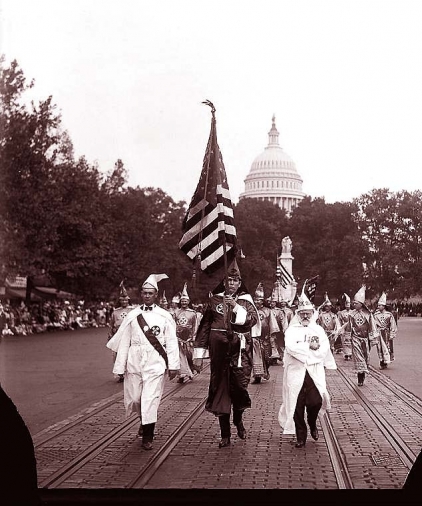
50,000 Klansmen March in Washington, D.C. (Literary Digest, 1925)
1925, Ku Klux Klan, Recent Articles, The Literary Digest

50,000 Klansmen March in Washington, D.C.
(Literary Digest, 1925)

A report on the August, 1925 KKK march in Washington, D.C.:
The parade itself marshaled ‘from 50,000 to 60,000 white-robed men and women’ as the correspondent of the The New York Times estimates, and H.L. Mencken tells us in the New York Sun:

The Klan put it all over its enemies. The parade was grander and gaudier, by far than anything the wizards had prophesied. It was longer, it was thicker, it was higher in tone. I stood in front of the treasury for two hours watching the legions pass. They marched in lines of eighteen or twenty, solidly shoulder to shoulder. I retired for refreshment and was gone an hour. When I got back Pennsylvania Avenue was still a mass of white from the Treasury down to the foot of Capitol Hill – a full mile of Klansmen…


Click here to learn about the origins of the term Jim Crow.

Advertisement

Advertisement

what happened to confederate gold after the civil war
1912, Civil War History, Recent Articles, The Literary Digest

The Missing Confederate Gold
(Literary Digest, 1912)

For many it will come as no surprise that the Confederate States of America entered it’s twilight with the same hubris and cupidity that gave it life. This 1912 article solved a mystery: what had become of the gold and silver from the vaults of the CSA when it finally became clear to all that the rebellion was over.


Click here to read a memoir of the Union victory parade in 1865 Washington.

Benito Mussolini Interview 1938 | Fulton Oursler Interview with Mussolini 1938 | Liberty Magazine Mussolini Interview 1938
1938, Benito Mussolini, Liberty Magazine, Recent Articles

‘I Am Not a Dictator”
(Liberty Magazine, 1938)

In 1938, Fulton Oursler (1893 – 1952), editor of Liberty, crossed the Atlantic Ocean in order to ask Benito Mussolini why he invaded Ethiopia and to get his thoughts as to whether there would be peace in Europe. We can’t say that Il Duce gave very thorough answers to those questions, but Oursler did find out what was eating Mussolini:

Why is it that the people of the United States are so against Fascism? What is the matter with them? Why is the whole press so bitter against Fascism? Can you answer me that?

Ethiopians Massacred by Italian Fascists 1937 | Mussolini Mass Execution in Ethiopia
1937, Ethiopia, Pathfinder Magazine

Massacre
(Pathfinder Magazine, 1937)

Late last week 30 prominent Ethiopians were tried as ringleaders in the attempted assassination [of Marshal Rodolfo Graziani]. They were to serve as public examples of Italy’s determination to rule over her new African domain. All other natives found in possession of arms were shot by Fascist firing squads, more than 1,000 terrified men being mowed down in a bloody Mussolini-ordered revenge.

Advertisement

19th October 1935 League of Nations Imposes Economic Sanctions on Italy
1935, Ethiopia, The Literary Digest

Italy Condemned
(Literary Digest, 1935)

Any of us born after 1945 have seen this before: the United Nations condemns a dreadful dictator and sends him a mean email and the dictator deletes it (Sadam Hussein was condemned 17 times by the U.N.) – but this was the first time it happened in the Twenties. The League of Nations condemned Mussolini for the Ethiopia invasion, and Mussolini couldn’t have cared less.

Resistance of Ethiopians to Italian Occupation | Italian Occupation of Ethiopia Resisted 1938
1938, Ethiopia, The Literary Digest

The Passive Resistance of the Native Population
(Literary Digest, 1938)

Recently former Viceroy Graziani cabled Mussolini that ‘my surveys demonstrate that tranquility is absolute. The native population is with Italy.’ But a writer in the Tribuna of Rome admitted that ‘nobody must delude himself with the idea that the former Shoan-Galla ruling caste have resigned themselves to the loss of their privileges and have welcomed our Italian Empire.’

Advertisement

Italian Occupation of Ethiopia 1937
1937, Ethiopia, The Literary Digest

‘Ethiopia Smolders”
(Literary Digest, 1937)

Italy’s financial and human resources are being heavily drained, not only by a vast [Roman] road-building program in the conquered kingdom, but particularly by the efforts of 200,000 men who compose the fascist expeditionary force to pacify a warlike population of 9,000,000 natives in a territory larger than France and Italy combined.

'War Fears in Italo-Ethiopia Rift'' (Literary Digest, 1935)
1935, Ethiopia, The Literary Digest

‘War Fears in Italo-Ethiopia Rift”
(Literary Digest, 1935)

A report on the start of the Italian adventures in Ethiopia:

The dispute arose over alleged trespasses by Ethiopians on Italian possessions in Eritria and Italian Somaliland, in East Africa.

A solemn declaration of Abyssinia’s peaceful intentions toward Italy was read in broken but emphatic Italian to representatives of the foreign press in Rome by the nervous and impassioned Negradsa Yesus, Abyssinian Charge d’ Affaires. In fervent tones he asserted that Abyssinia’s intentions were so peaceful ‘that if Italy remained without a single soldier and without a single gun in her colonies, Abyssinia would not touch a single stone.’


Mussolini explained why he invaded Ethiopia in this article…

Italian War on Abyssinia | Emilio De Bono Article 1937
1937, Ethiopia, The Literary Digest

The Italian Conquest of Ethiopia
(Literary Digest, 1937)

A column about Mussolini’s Minister of Colonies, Emilio De Bono (1866 – 1944) and his popular book, La Preparazione E Le Prime Operazioni:

Last week, with the appearance of a third printing, following a sold-out second edition (both of which were marked for publication in 1937), Italians at home and abroad noted certain deletions, including the passage which intimated that Mussolini had been on the point of abandoning his campaign in the face of British armed intervention.

Advertisement

Scroll to Top