

The Black-Shirt Revolution
(The Nation, 1922)
A report by Carleton Beals on Italy’s new order:
The strong state has arrived in Italy. It has been on the road ever since the failure of the factory seizures in September, 1920.

A report by Carleton Beals on Italy’s new order:
The strong state has arrived in Italy. It has been on the road ever since the failure of the factory seizures in September, 1920.

There are various reasons for Woodrow Wilson’s present preëminence. For one thing he represented, for years, the rights, under International Law, of the nations which were not in the war, and whatever his private opinions may have been as to an attitude of strict legality….Then, further, he is at the head of a nation which had no selfish motives in coming in. America wants for herself no new territory, no new spheres of influence. France wants Alsace and Lorraine. Italy wants ‘Italia Irridenta’. England, though she declared war to save France from being overrun through losing the channel ports, has gained incidentally all German Africa and the German islands of the South Seas…
Click here to read a 1913 article about Woodrow Wilson’s Under Secretary of the Navy: Franklin Delano Roosevelt…

Attached is an editorial that was co-authored by George Jean Nathan and H.L. Mencken from their reoccurring column in The Smart Set: Répétition Générale. This brief column sought to expose the damages inflicted upon the country by the guardians of the national virtue and their bastard children, Prohibition and the Volstead Act, which will primarily serve to promote the wide (though illegal) distribution of all the poorest distilled spirits concocted in the most remote frontiers of civilization.

It is not an interview with the Prime Minister. He is too busy to give interviews and his sense of fairness long ago forced him to make the rule of ‘no interviews’. If he couldn’t give an interview to all, he wouldn’t give an interview to one. But I spent two days with him and this story is of the Winston Churchill I got to know well in forty-eight hours.

Attached is an excerpt from a longer article about the U.S. Border Patrol’s adventures in Texas; it tells of one patrolman’s shocking discovery as to how abusive the growers were to their hired hands – how dreadful were their living conditions.

The gross quota allowance of immigration for the new year is the same as for the last, 357,803, of which 20% or 71,000 is the maximum which may arrive in any single month… Germany has sent only 43,000 immigrants, although her quota was 67,000.

In the midst of the Imperial Valley labor strife, on June 27, the U.S. House of Representatives passed a bill by a vote of 240 to 139 making it possible for farmers to hire illegally entered [Mexicans].

With the bad old days that spanned that period between October, 1929 through August, 1945 seen only in the rear view mirror, many Americans began to enjoy the high life that came with the booming post-war economy – a buying spree that wouldn’t slow until the mid Seventies. In the midst of so much plenty American magazines began to run articles about some of the folks who weren’t partaking in all the fun, and this article is a fine example – it is about the 2,000,000 white people who toiled in the fields of the San Joaquin Valley. Thirteen years later they would be outsourced by a labor pool willing to work for even less money.
… They get no unemployment insurance. They get no social security benefits. The law does not, in the main, protect them.
Click here to read about the horrendous living conditions of 1940s migrant workers…
Click here to read about the tremendous hardships that fell upon the fertile San Joaquin Valley in 1937…

When the skirt hems began to rise in the Twenties, it was widely understood that the vision of a woman’s leg was a rare treat for both man and boy; a spectacle that had not been enjoyed since the days of Adam (married men excluded). The flappers certainly knew this, and they generally believed that suffering the dizzying enthusiasm of the male of the species was a small price to pay in order to secure some element of liberty. The flappers liked their hem-lengths just where they were and, thank you very much, they were not about to drop them. Attached are some verses by an anonymous flapper who expressed her reaction regarding all that undeserved male attention her knees were generating.

[Berlin,] the target of 69 RAF raids so far, [the city] has been hit hard only a few times this year and underwent no raids during 1942. On the morale front it ranks ahead of all other German cities. When the others were raided the outcry of the Germans was bitter but local. When Berlin hit groans rose from all over Germany. If RAF night raiders should raze the capital by fire, as they did Hamburg, the whole German nation would suffer the shock of Berliners… Goebbels begged them to stand up under bombs as stoutly as the British did in 1940.

It’s a dirty, vicious war that Americans are [waging] in the swamps of South Vietnam. Men forget about the politics of Saigon when they stand gun to gun with the Communist guerrillas…

Posted herein is a report on the seven-month study on the effects marijuana has on military personnel that was conducted in 1944:
A great many of [the participants] attempted to form a compensatory image of themselves as superior people. ‘I could be a general like MacArthur. He looks smooth – like he’s high all the time.’

When the sun came up in 1935, it found that Jews had been designated a preferred risk by the insurance companies of the day. One member of the medical community looked into their reasoning:
That the Jews are the most nervous of all civilized peoples in the civilized world has been established as almost axiomatic in the medical profession.

This piece reported that the Manchester Guardian journalists who were posted to Nazi Germany were, without a doubt, the most reliable sources on all matters involving the violence committed by those brown shirted thugs during the earliest days of Hitler’s reign:
The ‘Brown terror does not exist in Germany, according to the Hitler dictatorship.
Even to talk about it is a penal offense. But the ‘Brown Terror’ goes on.
Read about the German POWs who were schooled in virtues of democracy.

The largest tank battle in history was fought on the Eastern Front during the Second World War. In April of 1943, 6,000 German and Soviet tanks, supported by some 2,000,000 infantrymen, had-at-it near the Russian city of Kursk. This article was written a year before the clash, and it informed the readers that armored engagements were becoming larger and larger with each one.
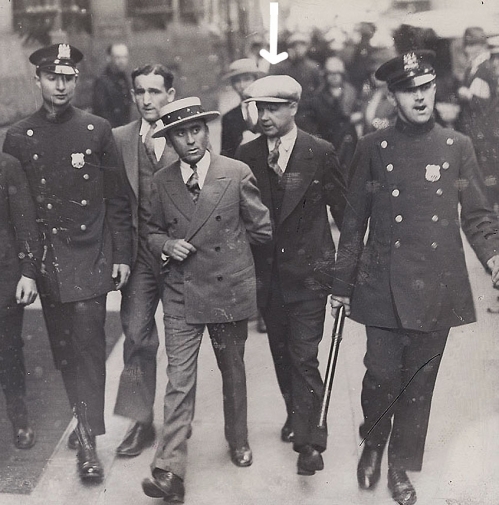
Few Times Square tourists recognize Johnny Broderick, but New York mobsters cringe at the mention of his name. Meet Broadway’s one-man riot squad in his own bailiwick, where the lights are brightest.
The words and deeds of Johnny Broderick were so widely known that visiting politicians would request that he take charge of their security details and the broadcasting moguls wanted to make radio shows celebrating his daring-do. His round-house punch was known far and wide; cops like this one do not come along too often.

During the closing days of 1937, Clarence Beck, Attorney General for the State of Kansas made a radio address on the Mutual Broadcasting System concerning the growing popularity of Marijuana:
It Is estimated the Narcotic Bureau of the New York Police Department in 1936 alone destroyed almost 40,000 pounds of marijuana plants, found growing within the city limits. Because of its rapidly increasing use, Marijuana demands a price as high as $60 a pound. (continued)

This article was penned in 1951 by Hank Hasiwar, a loyal New Deal Democrat and president of the National Farm Labor Union (formerly the Southern Tenant Farmer’s Union). His column was written in order to express his complete and utter outrage that there were members of congress who openly worked to undermine the welfare of American workers:
U.S. Senator Clinton Anderson (D-NM) made a strenuous attempt to flood the farming areas with hundreds of thousands of foreign nationals to be brought in at great expense to the taxpayers in order to provide cheap labor for the farm owners.