Author name: editor

Savoia Marchette SM 82: Italian Transport and Bomber (Alertman, 1942)
1942, America's Alertman, Weapons and Inventions

Savoia Marchette SM 82: Italian Transport and Bomber
(Alertman, 1942)

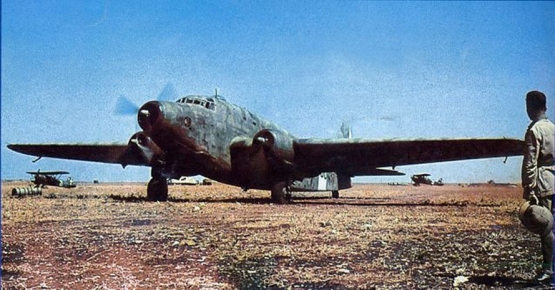
The Savoia Marchetti SM 82 Canguru was a triple engine transport aircraft that was also put to use as a bomber. Produced by the Italians, it was additionally used by their German allies and was capable of seating 40 fully-equipped soldiers comfortably or 51 fully-equipped soldiers uncomfortably. At the time this article appeared, this long-range transport was being used to shuffle German and Italian soldiers to the collapsing fronts in North Africa.

John Garand: Inventor of the M1 Garand (Click Magazine, 1944)
1944, Click Magazine, Weapons and Inventions

John Garand: Inventor of the M1 Garand
(Click Magazine, 1944)

Attached is a Click Magazine photo essay of one of the seldom remembered heroes of W.W. II: John C. Garand – the gunsmith who tripled the firepower of the American foot soldier.


In 1939, a German spy almost succeeded in delivering the blueprints of the Garand rifle into the blood-soaked hands of his Nazi overlords: read about it here.


Click here to read about the Japanese Zero.

Advertisement

Use shortcode [oma_ad position="summary_top"] (or other position) in your theme or widgets to display OMA Promotions here.

Japanese Aichi-99 Dive Bomber Information | WW2 Japanese Aircraft
1942, America's Alertman, Weapons and Inventions

The Japanese Aichi-99 Dive Bomber
(Alertmen, 1942)

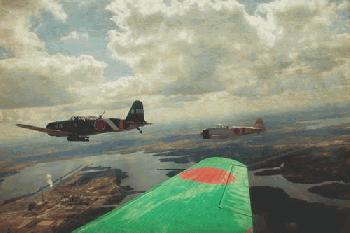
When, on December 7, 1941, the bombers and fighter aircraft of the Imperial Japanese Navy came roaring out of the Hawaiian blue to reign death and destruction on Pearl Harbor, the Aichi-99 was among those present. The attached article from 1942 will tell you all that the American military knew about it at the time.


Read about another plane that was at Pearl Harbor that morning…

Mitsubishi A5M
1942, PM Tabloid, Weapons and Inventions

The Japanese Zero
(PM Tabloid, 1942)

Soon after Pearl Harbor Americans began hearing about a Japanese warplane called called the Zero. It had an unusual name, it was virtually unknown, even to aircraft experts, and almost immediately it began to take on an air of sinister mystery. Information now available shows there is no good reason for the mystery, although the plane has been a big factor in the Jap drive… The Zero has no secret weapons or engineering developments. It is simply a pretty good pursuit or fighter.

The German JU-88 Heinkel Fighter Bomber (Alertman, 1943)
1943, America's Alertman, Weapons and Inventions

The German JU-88 Heinkel Fighter Bomber
(Alertman, 1943)

From the pages of a 1943 issue of America’s Alertman was this page that presented some information about the German JU 88 twin engine bomber, which was the primary offensive aircraft in the Luftwaffe’s arsenal during the Second World War. It was the successor to the Ju-87 and saw service as a night fighter and torpedo bomber in addition to serving as reconnaissance aircraft. The earliest prototype first flew in December of 1936 with a civilian registration of D-AQEN; it managed a top speed of 360 mph. Throughout the course of the war there were 15,000 JU 88’s constructed.

The attached article from 1943 goes into greater detail and can easily be printed.

Advertisement

Use shortcode [oma_ad position="summary_top"] (or other position) in your theme or widgets to display OMA Promotions here.

The American A-36 Fighter Bomber (Yank Magazine, 1943)
1943, Weapons and Inventions, Yank Magazine

The American A-36 Fighter Bomber
(Yank Magazine, 1943)

This article page from a 1943 YANK MAGAZINE concerns the American A-36 fighter-bomber of World War II. The article is accompanied by photographs and testimonial accounts as to how well the fighter aircraft performed in combat over North Africa and Sicily.

Built by North American Aviation, this ship is a dive-bomber version of that company’s P-51 Mustang fighter. The A-36 can climb at the rate of nearly half a mile a minute, with a ceiling of 30,000 feet. Powered by a 12-cylinder Allison engine, it has a flying speed in excess of 400 miles an hour…

The B-17 (Coronet Magazine, 1959)
1959, Coronet Magazine, Weapons and Inventions

The B-17
(Coronet Magazine, 1959)

The B-17 Flying Fortress was the most fabulous combat plane ever built. Like Douglas’ unretireable DC-3 airliner, the B-17 is history written in metal, a pivot of progress which helped influence an entire generation.

Perhaps more than any other plane, the B-17 beat Hitler. Its 640,036 tons of bombs on Europe, nearly the total dropped by all other U.S. planes combined, knocked out much of his industry, oil and railroads… The B-17 unveiled the era of strategic air power and turned man’s eye to the stratosphere and beyond.


Click here to read about the P-47 fighter plane.

Advertisement

Use shortcode [oma_ad position="summary_top"] (or other position) in your theme or widgets to display OMA Promotions here.

1945, Weapons and Inventions, Yank Magazine

The Undeveloped Weapons of the Nazi Scientists
(Yank Magazine, 1945)

The war was over when the U.S. Army Ordnance Department began snooping around all the assorted ÜBER-secret weapons labs and work shops where the pointiest headed Nazis were developing some truly far-seeing weaponry, inventions that they were never able to perfect (thankfully).

One of the most striking aspects of the attached article is the part when you recognize that it was the Nazi scientists who first conceived of such space-based weaponry as the Star Wars technology that was ushered in during the Reagan presidency (i.e.: the Strategic Defense Initiative). While in pursuit of their nefarious tasks, these same scientists also conceived of harnessing the powers of the sun in order to advance Hitler’s queer vision of the perfect world.


Click here to read about the firm belief held by the German Army concerning the use of motorcycles in modern war.

Death Dealers Squadron Peleliu 1945 | Napalm Deployed on Peleliu 1945 | WW II Napalm Use
1945, Collier's Magazine, Weapons and Inventions

Enter Napalm
(Collier’s Magazine, 1945)

The first use of napalm in the Second World War was by the U.S. Army Air Corps flying over Germany. This article reported that it was used by Navy over Saipan, the Army over Tinian and the Marines over Peleliu:

Now it is possible to tell one of the more dramatic fire-bomb stories: [During an eight day period] last October, on a section of Peleliu no bigger than a city block, the Death Dealer Squadron of the Second Marine Air Wing dropped more than 32,000 gallons of flaming gasoline on Jap cave positions and wiped them out.


Click here to read about one of the greatest innovations by 20th Century chemists: plastic.

Advertisement

Use shortcode [oma_ad position="summary_top"] (or other position) in your theme or widgets to display OMA Promotions here.

'How We Made the October Revolution'' (New York Times, 1919)
1919, Recent Articles, Soviet History, The New York Times

‘How We Made the October Revolution”
(New York Times, 1919)

Here is Leon Trotsky’s reminiscence of those heady days in 1917 that served as the first step in a 75 year march that went nowhere in particular and put millions of people in an early grave – this is his recollection of the fall of the Kerensky Government and the creation of the Union of Soviet Socialist Republics(R.I.P.).

THE REVOLUTION was born directly from the war, and the war became the touchstone of all the revolutionary parties and energies…


The review of the first English edition of Das Kapital can be read here…

1941 Paul Robeson Interview
1941, African-American History, The American Magazine

‘America’s No. 1 Negro”
(The American Magazine, 1941)

Paul Robeson (1898 – 1976) was a multi-talented man and this article lays it all out.

Paul Robeson thinks of himself as conclusive proof that there is no such thing as a backward race. Given a few generations of equal opportunities, he believes, any people – Eskimos, Malayans, Fijians or the Untouchables of India – can produce as talented statesmen, scientists, educators, inventors and artists as the whites.

FDR's ''Pack The Court'' Proposal (Pathfinder Magazine, 1937)
1937, Pathfinder Magazine, Recent Articles, Supreme Court-Packing

FDR’s ”Pack The Court” Proposal
(Pathfinder Magazine, 1937)

Attached is a break-down of President Roosevelt’s proposed legislation to rid the Supreme Court of six ornery justices by imposing a mandatory retirement age for the whole of the Federal Government. Failing that, FDR’s legislation would have granted the President power to appoint an additional Justice to the U.S. Supreme Court, up to a maximum of six, for every member of the court over the age of 70, in order to assure passage of all New Deal legislation.

Advertisement

Use shortcode [oma_ad position="summary_top"] (or other position) in your theme or widgets to display OMA Promotions here.

The Hats of 1947 (Collier's Magazine, 1947)
1940s Fashion, 1947, Collier's Magazine

The Hats of 1947
(Collier’s Magazine, 1947)

With the exception of the broad-brimmed sun hat pictured in the attached fashion editorial, you will find that women’s hats were growing smaller throughout the course of the Forties and they tended to sit farther back on the cranium, requiring hairdos that would accommodate and complement these creations.


The Sally Victor hat composed of red cherries took its inspiration directly from the bizarre, comical costumes worn by the actress Carmen Miranda. This fruit theme was typical of many post-war milliners. The six other hats in the piece were by two American designers: Lilly Dache and John-Frederics.

Click here to see what men’s summer hats were like during this period.

1940 s article about fashion models
1940s Modeling, 1944, Coronet Magazine, Recent Articles

Fashion Modeling in the 1940s
(Coronet Magazine, 1944)

Inasmuch as this 1944 article sums up the bygone world of the New York fashion model, the terms heroin chic and bulimia are not found on any of it’s five pages (an over site, no doubt). The Forties were a time when a model would be just as likely to get a booking from a commercial artist as she would a photographer, and, unlike the Twenties and the earliest days of the Thirties, it was a time when a standardized image of beauty was well-established.

– five feet nine inches in height, weight 110 pounds, bust 33, waist 24, hips 34, blonde or a light shade of brown hair. She will have quick, clever eyes and a very expressive face.
Many of the models are bitter, unhappy girls inside. They soon grow disillusioned with their dream of modeling as a gateway to theatrical glory; they learn that their height is against them.


Read about the attack of the actress/models!

Justice George Sutherland (Pathfinder Magazine, 1937)
1937, Pathfinder Magazine, Supreme Court-Packing

Justice George Sutherland
(Pathfinder Magazine, 1937)

Justice George Sutherland (1862 – 1942) was consistently on the reactionary side in votes against New Deal legislation. It was he who wrote the decisions invalidating the Guffey coal-control act and the powers of the SEC to interrogate witnesses. His NRA and the Municipal Bankruptcy Act, railroad pensions and hot oil legislation. He voted in favor of the TVA and old-age pensions.

Advertisement

Use shortcode [oma_ad position="summary_top"] (or other position) in your theme or widgets to display OMA Promotions here.

Scroll to Top