

That Night in Paris
(American Legion Weekly, 1924)
Whether or not this story is true or not, it’s a wonderful ride – written in the idiom of the American trench-dwellers of the time. It’s awfully funny.

Whether or not this story is true or not, it’s a wonderful ride – written in the idiom of the American trench-dwellers of the time. It’s awfully funny.

So they’ve given up.
They’re finally done in, and the rat is dead in an alley back of the the Wilhelmstrasse.
Take a Bow, GI – take a bow, little guy.
Far-flung ordinary men, unspectacular but free, rousing out of their habits and their homes – got up early one morning, flexed their muscles, learned the manual of arms (as amateurs) and set out across perilous oceans to whop the bejeepers out of the professionals.
And they did.

To mark the 1921 anniversary of Armistice Day, the editors put the word out to all their readers that they wanted to hear from them concerning where they were and what they were doing when they first heard that la guerre was fini – they received many answers, from both veterans and civilians alike.

A printable piece from a 1945 COLLIER’S MAGAZINE outlining how Sergeant Edward F. Younger (died August 6, 1942) selected which of the four unidentified Doughboys set before him would be interred in the Tomb of the Unknowns in Arlington Cemetery.

Brilliant photographer Ralph Steiner (1899 – 1986) spent some time examining the photographs of Murray Korman (1902 – 1961) and, to his surprise, came away finding his work to be very interesting:
Murray Korman is the man whose pictures you see outside the musical shows and in girlie magazines… After four hours of looking I was dizzy. I figured that no man could take such pictures for 17 years and get satiated with lusciousness and bored by the sameness of the girls. I figured that all that kept Korman going was the profit motive. But when I went to his studio on Broadway I found I was all wrong.

Who was it who deprived men of their suit vests and trouser cuffs? Who banned silk stockings? Who outlawed the flow in flowing skirts? Why, it was the War Production Board of course – click the title link if you want a name and a face…
The following four images were first published in Stephen J. Chambers’ remarkable book, Uniforms & Equipment Of The British Army In World War I
The afore mentioned British tailor’s journal West End Gazette remarked:
A feature (so far as tailors are concerned) of the European War is the variety of garments worn by officers, the details of which are suggested by the actual requirements of the campaign, rather than by the usual official regulations from the War Office. Never in the history of military tailoring, has such latitude been allowed, and officers are quick to recognize and avail themselves of the advantages of every practical design that is submitted for their approval.
Click here to read an old Vanity Fair magazine article about the trench coat.

An excerpt from a British tailoring journal which explains what the garment is and is not. The illustrations show a long forgotten pattern with billows pockets and excessively long cuffs, which were intended to be gathered by wrist straps. You will also note that the trench coat is bereft of D rings and gas flaps and other fantasy elements of military-tailoring.
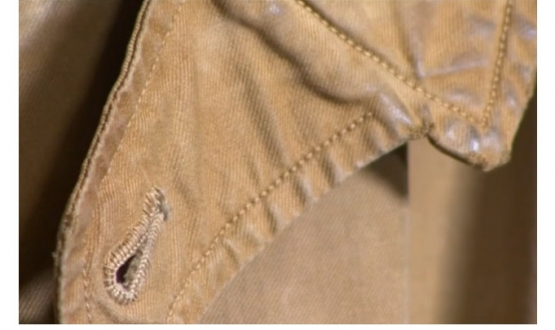
The fashion designers of the past ninety-four years all seem to be of one mind when it comes to the subject of the trench coat: it needs to be re-designed every four months. Years have passed, but still the garment has not reached a final state; meanwhile the rest of us only get one shot at a first impression. It is no matter whether the one who wears the trench coat is an actual trench-dweller or simply one who Tweets all day; the designers all have their opinions regarding the fluctuating number of straps and ‘D’ rings. There has been no end to the amount of cleverness applied to the re-treading of the garment and through the years we have been treated to doggy trench coats and lady’s evening gowns cut to resemble trench coats. Yet in the dark days of 1917, when the United States entered the fray, it was not lost on those who glanced at the attached column that too many of these raincoats were already buried in the damp grave yards of France and Belgium.
Click here to read about the fashion legacy of W.W. II: the t-shirt…

The kids who are discussed in this article would be called LD today – you don’t want to know how they were referred to in the early Twenties. Back then there were no Federally-funded commissions thronging with sympathetic PhD candidates to ramble on about convergence issues, processing concerns, the-classroom-learning-environment and the Learning Disabled. There were only frustrated kids, frustrated teachers and broken-hearted parents. This 1937 news article reports on the pioneering teachers at Seward Park High School in New York City and the earliest attempts to address the needs of students who suffered from language processing disorders, dyscalculia, dyslexia, dysgraphia and America’s favorite – good ol’ ADHD.

Here are the Chief accomplishments of the special Session of the 73rd Congress, March 9 – June 16, 1933
These fifteen pieces of legislation were called the Honeymoon Bills – his critics pointed out that not one of them originated in Congress and added to their argument that Congress had been marginalized during the earliest period of his presidency.
FDR’s critics had a thing or two to say about the first year of The New Deal…
Click here to read about FDR and the press.

This article was written by John Hersey (1914 – 1993); it was written as a review of Slightly Out of Focus, the memoir by the most famous of World War II combat photographers, Robert Capa (né Andre Friedmann: 1913 – 1954). A fun and informative read, you will learn how the man came to be a photographer, how he acquired his nom de guerre, his work during the Spanish Civil War and the credibility that quickly followed.
Click here to read what General James Gavin remembered about photographer Robert Capa.

An eyewitness account of the Windsors on their visit through Germany in 1937. The journalist reported that the two seemed nervous – reluctant to sign guest ledgers or photographed with Nazi leaders (except with Hitler, they seem very pleased in that photo).

On assignment for the Hearst papers, H.R. Knickerbocker (1898 – 1949) witnessed the total collapse of the French Army. He made his observations and conclusions available to American readers in his 1941 book Is Tomorrow Hitler’s?, which hit the bookshops shortly after Pearl Harbor.
If [The French] had ignored their low birth rate, been willing to spend lives, had retained the old offensive spirit traditional in the French Army, had known that they had to win or perish, had a Churchill to inspire and lead them, and had no traitors in their ranks, their comparative lack of weapons would not have mattered; they would still be fighting the Germans in France.
Click here to read the observations of U.S. Army Lieutenant Louis L’Amour concerning 1946 Paris.
Another article about a French general who collaborated with the Nazis can be read here…

A well-known writer consulted many different sources about that rarest of species, the New Yorker – he came away with these many different replies:
Yeah. New Yorkers are suckers, all right. They think they are so much smarter than anybody else, but they’re the biggest suckers of them all.

Doesn’t LBJ remind you of FDR?‘
That’s the question I hear most of these days. He does, and touring through the poverty-stricken states of Appalachia with President Johnson, I saw why.
– so wrote Franklin D. Roosevelt, Jr. (1914 – 1988) in the attached article that was penned some 23 years after his father’s death.

We were interested to learn that two of the most semi-popular queries on Google are, 1930s wedding theme decorations and 1930 wedding dress styles – yet to read the attached article is to learn that the most accurate step that any contemporary wedding planner assigned this theme can recommend is that the happy couple forego the nuptial ceremony entirely and simply move in together. During the Great Depression very few couples could afford to get married, much less divorced.

Here is a segment from a longer article published in 1951 by an anonymous American woman who wished to be known to her readers only as a women who had grown up with the Century (born in 1900). In this column she insisted that it was the First World War that served as the proving ground where American women showed that they were just as capable as their brothers – and thus deserving of a voice in government.