Author name: editor

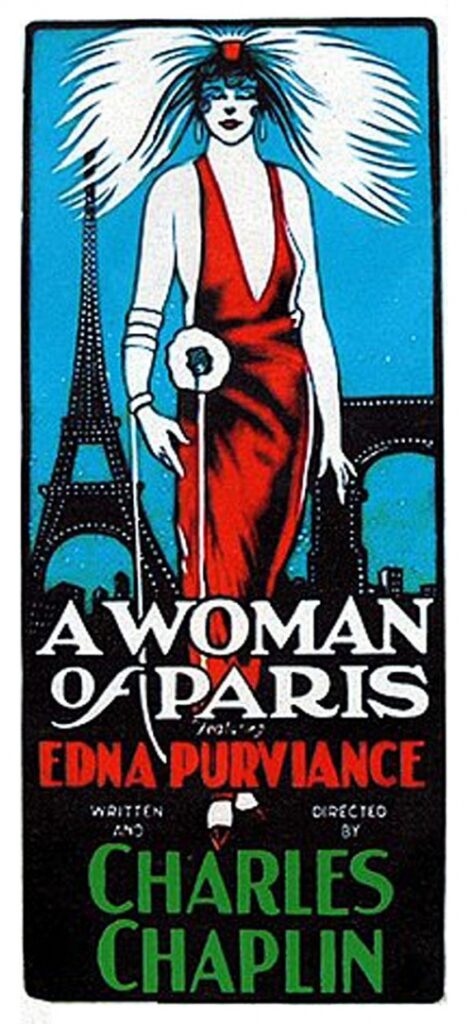
1923 A Woman of Paris Film Review Time Magazine 1923 | Charlie Chaplin Directs His Second Film 1923 A Woman of Paris
1923, Charlie Chaplin Articles, Time Magazine

A Woman of Paris
(Time Magazine, 1923)

The Time Magazine review of Charlie Chaplin’s film, A Woman of Paris, fell in line with many other reviews of the work: they all believed that Chaplin, as director, had moved the ball forward insofar as the development of film – and Time hoped that they had seen the end of Chaplin the clown. However, the 82 minute film was a commercial flop, primarily because he wasn’t in it (they chose not to publicize that he played an extra’s roll for one quick scene).


The first film Chaplin had directed was The Kid (1922) – and you can read about that here

Charlie Chaplin's Credo (Direction Magazine, 1941)
1941, Charlie Chaplin Articles, Direction Magazine

Charlie Chaplin’s Credo
(Direction Magazine, 1941)

This, the much-discussed final speech in The Great Dictator, is more than a climax and conclusion to Chaplin’s newest film, it is a statement of Chaplin’s belief in humanity, a belief in which his creative powers and artistic development are deeply rooted.

Hope…I’m sorry, but I don’t want to be an emperor. That’s not my business. I don’t want to rule or conquer anyone. I should like to help everyone, if possible -Jew, Gentile -black man -white.

Advertisement

Use shortcode [oma_ad position="summary_top"] (or other position) in your theme or widgets to display OMA Promotions here.

Post-World War 1 France by Alexander Woolcott 1920 | Post-World War I France in Ruins
1920, Aftermath (WWI), Recent Articles, The North American Review

Post-World War I France
(The North American Review, 1920)

In the later years of the First World War, the American journalist Alexander Woollcott (1887 – 1943) served as a writer for the Doughboy newspaper The Stars & Stripes. In this roll he was able to travel far afield all over the American sectors of the front where he saw a great deal of the war: flattened villages, ravaged farmland, factories reduced to ruble. In the attached article from 1920, Woollcott reported that the war-torn provinces of France looked much the same, even two years after the Armistice. He was surprised at the glacial speed with which France was making the urgent repairs, and in this article he presented a sort-of Doughboy’s-eye-view of post-war France.


More on this topic can be read here

Advertisement

Use shortcode [oma_ad position="summary_top"] (or other position) in your theme or widgets to display OMA Promotions here.

Japanese Spies in the USA 1930 - 1940 | Toshito Sato Japanese Spy
1940, PM Tabloid, Recent Articles, Spying

Japanese Spies and Their Many Troubles
(PM Tabloid, 1940)

From the 1940 editorial pages of PM came this column by Henry Paynter (1899 – 1960) who wrote amusingly about the many frustrations facing Japanese spies in North America.

The identity of almost every Japanese spy or saboteur has been known to U.S. authorities. Every instruction they have received or sent has been decoded…


At the height of their irritation, they confided in the German Consul-General stationed in San Francisco – only to learn after the war that he was an FBI informant (you can read about him here).

GRAPHIC ARTS USA Exhibit Seymour Chwast and Milton Glaser | GRAPHIC ARTS USA Exhibit USIA
1964, Design, Pageant Magazine, Recent Articles

American Graphics Seen in Soviet Russia
(Pageant Magazine, 1964)

An exhibition of graphic art from the United States has become a tremendously popular attraction [as it toured throughout four cities within the Soviet Union]… In the first two days more than 17,000 Soviet citizens, most of them in their teens or early twenties, came to see a gay collection of funny American posters, preposterous ads, colorful book covers and abstract prints.

‘You mean you’re really allowed to paint like this, and nobody says anything?’ one of the visitors asked.

Advertisement

Use shortcode [oma_ad position="summary_top"] (or other position) in your theme or widgets to display OMA Promotions here.

The Very First Football Referee Hand Signals (Literary Digest, 1929)
1929, Football History, Recent Articles, The Literary Digest

The Very First Football Referee Hand Signals
(Literary Digest, 1929)

With the widespread complaints on the rise from the football fans on the sidelines that they were completely in the dark as to why a play was called, the elders of the sport decided that action had to be taken to remedy the growing confusion…

Hence a system of signals has been devised whereby the officials on the field can let the people in the stand know what is what. A gesture of the arm by the field official will immediately telegraph to the stands that Whoozis College’s penalty was for slugging. Another wave will inform the inquisitive public that the forward pass was incomplete by being grounded.

The article is illustrated with eight photographs of assorted football penalty hand signals; none of the gestures have stood the test of time – the penalties have remained but today different signals indicate each infraction.

Advertisement

Use shortcode [oma_ad position="summary_top"] (or other position) in your theme or widgets to display OMA Promotions here.

Judith Coplon in Federal Court (Pathfinder Magazine, 1949)
1949, Pathfinder Magazine, Spies

Judith Coplon in Federal Court
(Pathfinder Magazine, 1949)

FBI agents arrested Judith Coplon (1921 – 2011: Soviet code name Kompid) on March 4, 1949 in Manhattan as she met with Valentin Gubitchev, a NKVD official employed at the United Nations, while carrying what she believed to have been secret U.S. government documents in her purse. Hoover’s G-Men FBI were certain that Coplon, a secretary at the Federal Justice Department, was colluding with the Soviet agents in Washington but to prove their case conclusively would compromise an ongoing counter-espionage project called the Venona Project. The failure to prosecute this case successfully began to shed doubt upon the FBI director and his credibility in matters involving Soviet spy-catching.– read about that here…


Years later Coplon’s guilt was made clear to all when the Venona cables were released. However our laws mandate that it is illegal to try a suspect twice for the same crime and she was released.

Opening Successes of Operation Barbarossa 1941 | Operation Barbarossa Newspaper Report 1941
1940, Eastern Front, PM Tabloid

The German Eastward Thrust
(PM Tabloid 1941)

Sub-surface evidence that the war on the Russian Front is going into a more crucial phase is mounting… if the present German drive achieves the bulk of its objectives, the Russians will have had some of their resistance power taken away from them. They will not have quite the same communications, the same supply facilities or the same freedom of movement they have had to work with thus far.

Beautiful Girls Wanted (Coronet Magazine, 1948)
1948, Advertising, Coronet Magazine

Beautiful Girls Wanted
(Coronet Magazine, 1948)

American advertising struck pay dirt when it discovered the super salesgirls whose irresistible allure will sell anything from a bar of soap to a seagoing yacht…Always there was the secret whisper of sex. For women it was, ‘Be lovely, be loved, don’t grow old, be exciting’… For men it was, ‘Be successful, make everyone know that your successful, how can you get women if your not successful?’

Advertisement

Use shortcode [oma_ad position="summary_top"] (or other position) in your theme or widgets to display OMA Promotions here.

WW2 Propaganda Radio Broadcasts | American 1940s Radio Programming |DIRECTION Magazine Content
1941, Direction Magazine, Radio History, Recent Articles

Propaganda Radio
(Direction Magazine, 1941)

This magazine article first appeared on American newsstands during February of 1941; at that time the U.S. was ten months away from even considering that W.W. II was an American cause worthy of Yankee blood and treasure; yet, the journalist who penned the attached column believed that American radio audiences were steadily fed programming designed to win them over to the interventionist corner. He believed that it was rare for isolationists to ever be granted time before the microphones and quite common for newscasters to linger a bit longer on any news item that listed the hardships in France and Britain. Objectivity was also missing in matters involving the broadcasting of popular song:


The morning after the Japanese attack on Pearl Harbor President Roosevelt stood before the microphones in the well of the U.S. Capitol and became the first president to ever broadcast a declaration of war; CLICK HERE to hear about the reactions of the American public during his broadcast…

WPA Music Projects in NYC | WPA Symphony Orchestras in NYC During the 1930s
1941, Newsweek, Recent Articles, WPA

The WPA Symphony Orchestras
(Newsweek Magazine, 1941)

This article lays out the enormity of the WPA Music Projects in the City of New York during 1941 – It sponsors the most extensive musical organization ever assembled in one city: two symphony and eight dance orchestras, two bands, two choral groups and three ensemble employing some 500 musicians, not to mention 96 music centers with 188 teachers instructing 22,000 students.

Women Worked the Farms During WW2 | ww2 Farm Labor Shortage | WW2 Draft Deferments for Farmers
1943, Click Magazine, Women (WWII)

Women Worked The Farms
(Click Magazine, 1943)

Although the Selective Service agency granted 4,192,000 draft deferments to farmers throughout the course of World War II, the U.S. Department of Agriculture recognized that this number alone would never be enough to harvest the food necessary to feed both the home front and the armed forces. With this shortage in mind, the Women’s Land Army was created in 1943 to provide that essential farm labor that proved so vital in winning the war. Between the years 1943 and 1945 millions of American women from various backgrounds rolled up their denim sleeves and got the job done. The attached magazine article is one of the first to tell the tale of this organization, and was printed at a time when there were only 60,000 women in the field.<

Advertisement

Use shortcode [oma_ad position="summary_top"] (or other position) in your theme or widgets to display OMA Promotions here.

Scroll to Top