Author name: editor

Actor Lew Ayres: Conscientious Objector (Yank Magazine, 1944)
1944, Hollywood, Yank Magazine

Actor Lew Ayres: Conscientious Objector
(Yank Magazine, 1944)

This short notice from a 1944 issue of the U.S. Army’s Yank Magazine can be printed or read on screen if you prefer; the article is accompanied by a photo of Lew Ayres (1908 – 1996: Ayres is best remembered for his performance in All Quiet on the Western Front) wearing his Army togs while performing his tasks as a chaplain’s assistant on Wake Island (New Guinea).

‘I am still a conscientious objector to war,’ Ayres says. He went to a camp for conchies at Wyeth, Oregon early in 1942 but volunteered a short time later for medical service. After training as a hospital ward attendant and then becoming an instructor at Camp Barkley, Texas, the ex-movie actor shipped overseas as a staff sergeant.


Click here to read more about American conscientious objectors in W.W. II.

Flight Officer Lawrence Olivier (Photoplay Magazine, 1942)
1942, Hollywood, Photoplay Magazine

Flight Officer Lawrence Olivier
(Photoplay Magazine, 1942)

When the actor Lawrence Olivier (1907 – 1989) first heard that a state of war existed between Britain and Germany, he was enjoying the breezes off the shore of Southern California in a sailboat skippered by Hollywood’s heir expectant, Douglas Fairbanks, Jr., and it was to Fairbanks that the attached letter was addressed. When this letter was written, Olivier was posted to the Royal Navy Fleet Air Arm where he gained the understanding that aeronautics was an acquired taste, and one that he simply could not cultivate. In his book International Stars at War, author James Wise noted that Flight Officer Olivier would soon be judged incompetent by the Royal Navy and released for other duties more in line with his abilities (like writing this highly self-conscious letter to his Hollywood friend).


Fairbanks, on the other hand, played an important roll in the U.S. Navy and by the war’s end was sporting a chest-full of ribbons.

Since You Went Away Movie Trivia | Since You Went Away Movie History | 1944 Popular Movies
1944, Click Magazine, Hollywood

Tears in the Dark of the Theater
(Click Magazine, 1944)

Even the broad-shouldered, steely-hard men who toil daily over this website cry like little girls when exposed to the 1944 home front movie, Since You Went Awaystyle=border:none; for our money it was the best movie Hollywood ever produced about the war years.


That said, we invite you to take a gander at the attached photo-essay from CLICK MAGAZINE in which a spy camera using infrared film was used to capture the weeping masses sobbing in the dark of the theater as they watched that remarkable movie.

Advertisement

Use shortcode [oma_ad position="summary_top"] (or other position) in your theme or widgets to display OMA Promotions here.

Hollywood Stars Cope with Food Rationing (Collier's Magazine, 1943)
1943, Collier's Magazine, Hollywood

Hollywood Stars Cope with Food Rationing
(Collier’s Magazine, 1943)

If you ever wondered how Lucille Ball, Red Skelton, Barbara Stanwyck, Carmen Miranda, Veronica Lake, Charlie McCarthy or Edgar Bergen prepared their respective meals during the bad ol’ days of food rationing during W.W. II – then you’ll get your answer here:

Hollywood has done a complete about-face and banned the lavish, costly dish…. These days when the inhabitants of Glamor Town take off their faces and sit down to dine, the taste may be varied, but every meal is eaten with the full knowledge that a quarter of a pound of butter or a pound of ground steak is just as rare in Hollywood as Wheeling, West Virginia.

Shooting Scenes Between Air Raids (Stage Magazine, 1940)
1940, Hollywood, Stage Magazine

Shooting Scenes Between Air Raids
(Stage Magazine, 1940)

An article about director Gabriel Pascal (1894 – 1954) and all the assorted difficulties set before him, his cast and his crew while filming George Bernard Shaw’s Major Barbara during the bombing of England in 1940.


Much of the article is composed of diary entries by an anonymous member of the cast:

After dinner we had a script conference off the lot and kept on working through the air raid sirens, relieved to be away from the studio discipline. Tonight the sky was one vast blaze of searchlights, and no sleep for anyone. It’s tough staying up all night and trying to work between raids all day…

Filming the War (Newsweek Magazine, 1945)
1945, Hollywood, Newsweek

Filming the War
(Newsweek Magazine, 1945)

The True Glory is a documentary film about the Allied victory in World War II using actual footage from the war; the film was a joint effort between Great Britain and the United States intending to show the team work that won the war. Beginning with the D-Day invasion of Normandy Beach, the film chronicles the collapse of the Nazi war machine on the Western Front:

This is the sort of film the Germans would never have made – because it shows our victories without gloating and admits setbacks like the Ardennes breakthrough; because it’s peppered with humor and because, at the end, it warns against repetition of such a war.

Advertisement

Use shortcode [oma_ad position="summary_top"] (or other position) in your theme or widgets to display OMA Promotions here.

Jimmy Stewart - One of the First Volunteers (Newsweek Magazine, 1941)
1941, Hollywood, Newsweek

Jimmy Stewart – One of the First Volunteers
(Newsweek Magazine, 1941)

A few weeks before this article went to press, actor Jimmy Stewart had been told by the hardy souls at the U.S. Army induction center that he was ten pounds under weight – too light for a man of his stature (6’4). A few visits to Chasens, among other assorted Hollywood eateries and he was all set to qualify as the first Hollywood star to enter the U.S. Army Air Corps.

1920s Road Rage (The American Magazine, 1927)
1927, Cars, Recent Articles, The American Magazine

1920s Road Rage
(The American Magazine, 1927)

Is it possible for a person to drive an automobile and remain a human being?

Do gasoline and courtesy mix?

Can you tell me why Ottis Throckmorton Whoozies, secretary of the Golden Rule Society, will smile sweetly, lift his hat and say graciously, ‘I beg your pardon. I’m really awfully sorry. Please excuse me,’ when he accidentally steps on a strange woman’s foot in a theater lobby, yet will lean out and make faces at his own grandmother if she fails to slow up her flivver and allow him to ‘cut in’ on a congested highway?

There’s something about a windshield that distorts a man’s outlook on life.


Click here to read about Lincoln, the joke teller.

1923 Time Magazine Review of Flaming Youth Starring Colleen Moore
1923, Flappers, Time Magazine

Flaming Youth
(Time Magazine, 1923)

Here is an entirely unsympathetic Time Magazine review of the 1922 film, Flaming Youth starring Colleen Moore and Milton Sills. The uncredited reviewer really wasn’t buying any of it and was not at all impressed with the morality of Flappers. Today, Flaming Youth has deteriorated to just just a few feet of film and rests in the vaults of the Library of Congress; the reviewer probably would be pleased to know that.

Advertisement

Use shortcode [oma_ad position="summary_top"] (or other position) in your theme or widgets to display OMA Promotions here.

The Back-Hand from a Flapper (Flapper Magazine, 1922)
1922, Flappers, Recent Articles, The Flapper Magazine

The Back-Hand from a Flapper
(Flapper Magazine, 1922)

Flapper Magazine crowned itself the

official organ of the national flapper’s flock

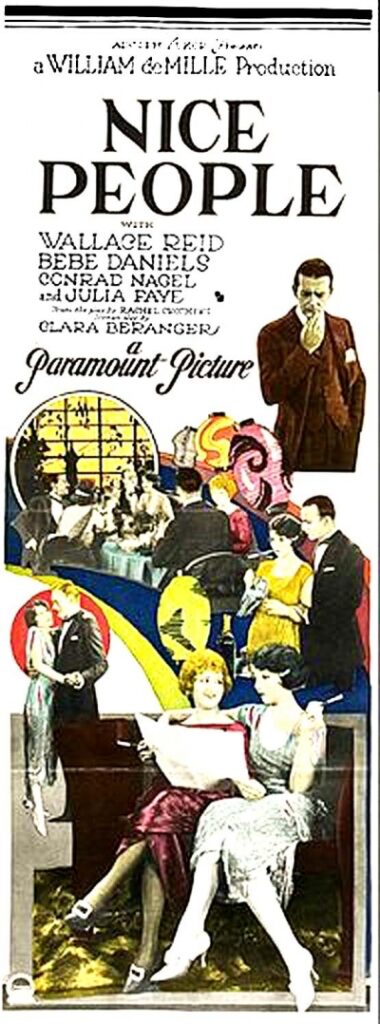
If nothing else, this verbiage simply spells out that the editors took themselves very, very seriously indeed and it was in that same spirit they gleefully went to work disemboweling a movie that they saw as anti-flapper to its very core. The film in question was

Nice People (Paramount, 1922) starring Bebe Daniels and Wallace Reid. Produced by Willam C. deMille (1878 – 1955), elder brother of Cecil, the film makers were clearly intimating that nice people will always keep their flapper daughters in line; it is at that point in the flick when the reviewer dipped her pen in the ink:

This is one of the themes that ‘old fogies‘ usually delight in; the ‘reformation’ of the flapper… The picture is replete with pithy subtitles, such as ‘the smart girl of today removes the rouge from her lips only to kiss and make up.’

Mein Kampf Reviewed (L.A. Times, 1940)
1940, Adolf Hitler, The Los Angeles Times

Mein Kampf Reviewed
(L.A. Times, 1940)

1940 was a pretty good year for Adolf Hitler, but then the L.A. Times review of Mein Kampf came out:

It is obviously the book of an ignorant man, unaccustomed to logic or literature. It is sincere, and done in the style of the soap-boxer, the rabble-rouser. And it is Red; redder than any of the utterances of Emma Goldman or the I.W.W. street speakers. What Hitler calls National Socialism seems to us, although the man denies it on page after page, merely another form of Stalinistic Communism, only this is the German variety…his system blots out the businessman, banker, manufacturer, professional man, teacher, writer, and artist – just as effectively as Stalin’s [Soviet’s]; property goes to the state in both cases; and all freedom of press, church and person dies as wholly in Germany as in Russia.

Finally, to an American, a lemon by any other name, is just as sour.


•You might like to read a more thorough review of Mein Kampf

Elsa Schiaparelli Recommends...(Photoplay Magazine, 1936)
1930s Fashion, 1936, Photoplay Magazine

Elsa Schiaparelli Recommends…(Photoplay Magazine, 1936)

Elsa Schiaparelli (1890 – 1973), Paris’ leading fashion authority of the 1930s tells how to dress inexpensively and yet look smart as a star.:

Cheap jewelery should never be worn unless it happens to be something that you positively know suits you. Pearls, including cheap ones, are always in good taste.

Women can learn from men and improve their ‘chic’. A man wouldn’t think of wearing a tight shoe or one that didn’t harmonize with his suit.

Advertisement

Use shortcode [oma_ad position="summary_top"] (or other position) in your theme or widgets to display OMA Promotions here.

A Pat on the Back for the Doughboys (The Stars and Stripes, 1919)
1919, Doughboys, Recent Articles, The Stars and Stripes

A Pat on the Back for the Doughboys
(The Stars and Stripes, 1919)

The attached Stars & Stripes article briefly summarizes the American efforts from Cantigny to the Armistice and serves as one big attaboy for the whole Doughboy army. The journalist anticipates John Mosiere’s World War One history, The Myth of the Great Warstyle=border:none, which opines that it was the high morale and seemingly endless supply lines of the A.E.F. that served as one of the most decisive factors in bringing the war to a close.

Stars & Stries could not have agreed more.

Ten years later a Frenchman writing for La Revue Mondiale would say essentially the same thing, click here to read that article.


Click here to read an article about life in a W.W. I German listening post…

The Eight World War One American Cemeteries (Literary Digest, 1923)
1923, Cemeteries, Recent Articles, The Literary Digest

The Eight World War One American Cemeteries
(Literary Digest, 1923)

Written five years after the Armistice, this is an article about the eight U.S. W.W. I cemeteries that were erected in Europe (with the help of German P.O.W. labor) and the money that was set aside by the veterans of The American Legion to aid in the upkeep of these memorials:

The American flag is still in Europe, even tho the last Doughboy has left the Rhine. It floats over eight cemeteries, six in France, one in Belgium and one in England…It is the high honor of the American Legion to represent the American people in the fulfillment of the sacred national obligation of decorating the graves of our soldiers abroad on Memorial Day. The Legion pledges itself always to remember and honor our dead on foreign soil on the day when the heart of all Americans is thrilling with reverence for them.

Front-Line Sergeants Talk Combat and Rant About Replacements (Yank Magazine, 1945)
1945, World War Two, Yank Magazine

Front-Line Sergeants Talk Combat and Rant About Replacements
(Yank Magazine, 1945)

The editors of Yank assembled six veteran platoon sergeants to talk about mistakes that most U.S. Army replacements make when they go into combat, and to speak seriously about which weapons and small unit tactics work best when confronting the German enemy:

The first mistake recruits make under fire began T/Sgt. Harry R. Moore, rifle platoon sergeant from Fort Worth, Texas, is that they freeze and bunch up. They drop to the ground and just lie there; won’t even fire back. I had one man just lie there while a German came right up and shot him. He still wouldn’t fight back.


<Click here to read about how the Army addressed the problem of soldiers who wouldn’t pull their triggers…

Advertisement

Use shortcode [oma_ad position="summary_top"] (or other position) in your theme or widgets to display OMA Promotions here.

U.S. Cemeteries: A Flag for Every Grave (American Legion Weekly, 1920)
1920, Cemeteries, Recent Articles, The American Legion Weekly

U.S. Cemeteries: A Flag for Every Grave
(American Legion Weekly, 1920)

An article that appeared in an American veterans magazine concerning the pageantry that would mark the Memorial Day of 1920 at each of the primary A.E.F. cemeteries in France.

More than 127,000 American soldiers, sailors and Marines gave up their lives during the war…Total battle deaths in the A.E.F. killed in action and died of wounds were 50,329 including casualties in the Siberian force. Deaths from disease including the A.E.F. and men in the home cantonments, were 58,837…No American field of honor will be without it’s Memorial Day ceremony, no American grave without its flag and its flowers…

An interesting article that was written at a time it was believed that the A.E.F. cemeteries were going to be closed and the interred repatriated. There is a photograph of an early prototype headstone that was later rejected in favor of a stone cross; references are made to Suresnes Cemetery in Paris.

Advertisement

Use shortcode [oma_ad position="summary_top"] (or other position) in your theme or widgets to display OMA Promotions here.

Scroll to Top