







Cartoons (WWI)

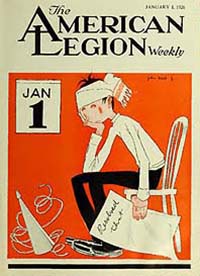
Armistice Cartoon
(American Legion Weekly, 1919)

A cartoon that appeared in an American veterans magazine on the first anniversary marking the last day of W.W. I. What is especially amusing is the satirical depiction of American combat officers and the last frame, which fully supports the thesis of Joseph E. Persico’s book, 11th Month, 11th Day, 11th Hour that the American Army was on the attack all the way up to the bitter end.

Kultur
(The New York Times, 1915)

During the course of the Great War, few German terms delighted English speaking cartoonists more than the word kultur -which is the Teutonic word for civilization or cultural progress. Prior to being picked up by the New York Times, this cartoon originally appeared in a London magazine called, The Sketch, and was drawn by W. Heath Robinson (dates?).

Advertisement

The German Occupation of Manhattan
(Vanity Fair Magazine, 1916)

The famed Conde Nast illustrator from days of old, Ann Fish, assumed the nom de guerre, Hello in order to impart to her well-fed audience the terror of German Prussianism. In this cartoon, she illustrated what a German invasion of Manhattan would look like.

Rea Irvin and the New York Home Front
(Vanity Fair Magazine, 1915)

This cartoon pokes fun at the high cost of being charitable. Throughout much of World War One there was always the problem of what to do with the growing number of refugees and orphans -and the answer was never cheap. This drawing reveals a different Rea Irvin, but the drawing style for which he would be remembered is clearly emerging.

Advertisement

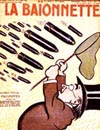
Five French Cartoons
(La Baionnette, 1916)

Five remarkable color cartoons from France. Modern Satirical art at this time was exceptional. KEY WORDS: La Baionette 1914-1918,Cartoons 1916,French Cartoon 1916,Modern Satirical Art 1914-1918,Satiric Art 1916,Crown-Prince Wilhelm Cartoon 1916.

Click here to see how weird the first car radios looked.

Advertisement

An Anti-Interventionist Cartoon
(The Masses, 1917)

The socialist New York magazine The Massesstyle=border:none maintained that the 1914 – 1918 war in Europe was not a concern for Americans and this is a great cartoon by the cartoonist Cornelia Barns (1888 – 1941) to illustrate the point; Barns was also one of the magazine’s editors.

War Profiteers
(Life Magazine, 1919?)

Although the year 1919 (and spanning throughout much of the Twenties) was a period marked by a strong sense of anti-communism in the United States, the words war profiteer proved to be a term capable of getting a good many people in both camps riled up. This is a fine cartoon by Rollin Kirby that nicely satirizes that low breed of opportunist.


Click here to see how weird the first car radios looked.

Advertisement

Franz Joseph: Geezer Emperor
(La Baionnette, 1915)

There was once a time when magazine editors would not endeavor to encourage their cartoonists to pursue punchlines that were insensitive to the aged members of the world community, but that was a long time ago; in the attached WW I cartoon, a French satirical artist indulged his pettiness – daring the Politically Correct generations yet un-born to label him an ageist.

Who Won World War One?
(Life Magazine, 1927)

Who won the war? asks the satirist Herb Roth (1887 – 1953) in this cartoon that appeared in print ten years after America’s entry into the war.

By the time 1927 rolled around, the popular opinion across the Western world was that the war of 1914 – 1918, and the subsequent peace treaty that followed, was a big mistake that left a bad taste in everyone’s mouth. Although there was paper work indicating that World War One was victoriously brought to a close by the collective strength of the French, British, and American armies (among other nations) – by the time 1927 rolled around it didn’t feel like anyone’s victory.

Click here if you would like to read about the 1918 Armistice Day celebrations in Paris.


Click here to read about W.W. I art.

Anticipating the Distasteful Ending
(The Masses, 1914)

Although not known as a clairvoyant, this 1914 cartoon by the New York artist John Sloan (1871 – 1951) seemed to predict the lousy ending that would play out four years after W.W. I reached its bloody climax.

Advertisement

Crown Prince Wilhelm Cartoon
(Life Magazine, 1919)

Attached is a caroon created in response to the memoir of Crown Prince Wilhelm (1882-1951), which came out earlier that same year (the review is posted on this site), this cartoon was drawn by Gluyas Williamsstyle=border:none (1888-1982) a cartoonist who is largely remembered by current generations for his contributions to THE NEW YORKER as well as his illustrations for a series of books by humorist Robert Benchley. In 1910, Williams served as Editor of ‘The Harvard Lampoon’ and upon graduation a year later began a brilliant freelance career as a cartoonist for ‘The Century Magazine’, ‘Collier’s’ and ‘Judge’ among others.

Click here to read about the woman who entertained the U.S. troops during the First World War.

Manhattan Servant Problems
(Vanity Fair, 1918)

The attached cartoon depicted one of the unintended consequences of German aggression during the First World War: the creation of what was known as the servant problem. It should be understood that the difficulty in question caused no particular hardship for those who were supposed to be the servants; they were simply delighted to vacate the collective domiciles of Mr. & Mrs. Got-Rocks in order to pull down a living wage in a nice, cozy smoke-spewing armament factory some place – leaving their former employers to fix their own meals and diaper junior.


Click here to read about the New York fashions of 1916.

Scroll to Top