Death Camps

Learn about Nazi concentration camps with these old magazine articles. Find information on Nazi concentration camps in the 1940s.

”Death Camp for Children”
(PM Tabloid, 1945)

As if Auschwitz, Dachau, Buchenwald, Nordhausen and Bergen-Belsen weren’t bad enough – in late April, 1945, advancing Soviet infantry reported that:


“The Red Army had found a concentration camp for children at Konstantinov, beyond Lodz in central Poland…There were 862 children in the camp, all Russian, White Russian and Ukrainian.”
Ravensbrück
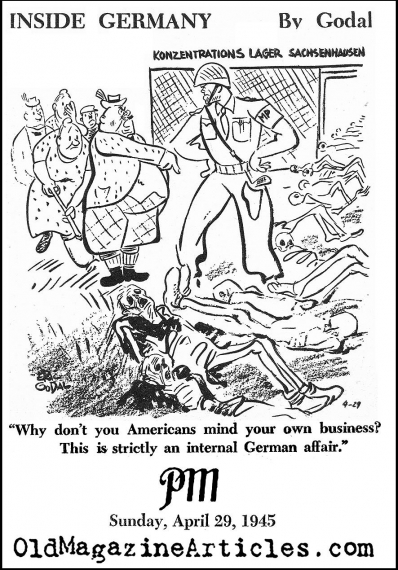
(PM Tabloid, 1945)

Here is an eyewitness account of the daily life at Ravensbrück concentration camp. Ravensbrück was the largest concentration camp for women in Germany. The Germans gassed between 5,000 and 6,000 prisoners at Ravensbrück before Soviet troops liberated the camp in the April of 1945.

Bergen-Belsen Survivor Speaks
(PM Tabloid, 1945)

Abigail Spannjard was an American citizen of Jewish heritage who was incarcerated in Bergen-Belsen with her husband and teen-age son. They were released early in 1945 as part of a prisoner-swap, and the account she gives of the abuses they endured is chilling.

Advertisement

Memories of Bergen-Belsen
(PM Tabloid, 1945)

Here are the observations of Patrick Gordon Walker (1907 – 1980), a broadcast journalist with the BBC who was present with the British Army when they liberated the Bergen-Belsen Death Camp on April 15, 1945.


“Men were hung for hours at a time, suspended by their arms, hands tied behind their back in Belsen. Beatings in workshops were continuous, and there were many deaths there. Just before I left the camp, a crematorium was discovered.”

New Yorkers See the Films
(PM Tabloid, 1945)

“New Yorkers sat in stunned silence yesterday as they watched the incontrovertible proof of the unbelievable – the U.S. Army Signal Corps motion pictures of Nazi horror camps and charnel houses… People came out of the theaters shaking their heads, or gazing blankly off into space, or cursing them under their breaths. They produced mixed reactions – a mixture of horror, of grief, of anger, of hate.”


We should reduce Germany to dust. The Germans can’t be trusted, and we have to watch Argentina and Spain.”

Advertisement

Report on Buchenwald
(PM Tabloid, 1945)

This chronicle on the Nazi concentration camp Buchenwald was written by the senior American officers of the Displaced Persons Division, U.S. Group Control Council for the Supreme Headquarters Allied Expeditionary Forces of the U.S. Department of War. It explains when and why the “camp” was created, who it was intended to incarcerate and how many.

Nazis Shrugged-Off Atrocities
(PM Tabloid, 1945)

At the invitation of General Eisenhower, the most prominent newspaper editors in the country crossed the Atlantic to witness the atrocities that transpired at Nazi concentration camps. They were shocked to find that the German people ‘feel absolutely no sense of guilt.‘”


The Terror of Buchenwald
(PM Tabloid, 1945)

Here is an eyewitness account of the Buchenwald Concentration Camp as experienced by U.S. Representative Clare Boothe Luce (R, Connecticut, pictured above):


“It was policy, Nazi policy, to work them and starve them and then throw them in the into the furnaces when they could no longer struggle to their feet. Dead men tell no tales. Well, the 51,000 dead of Buchenwald are talking now, and they are telling the people of the Democracies that they will have died in vain, unless we know and believe what excruciating sufferings they endured.”

Advertisement

Discovering the Deathworks
(PM Tabloid, 1945)

“American troops in Germany last week hit the Nazi death camp belt, an area that revealed such horrors – the bodies of thousands of Allied prisoners shot, starved, beaten and burned to death – that even the cynics of the civilized world now could not fail to be convinced of the truth of German atrocities.”

An American Corpse at Ohrdruf Concentration Camp
(Yank Magazine, 1945)

From time to time, it was the practice of the German military to separate American Jewish soldiers from their fellows and transfer them to concentration camps. The corpse of one of these men was found at the Nazi concentration camp in Ohrdruf, Germany.


Click here to read about the malnourishment and starvation of Allied prisoners of war…

Advertisement

Slaughter of the Innocents’
(See Magazine, 1943)

Terrible accounts of the Nazi murders that took place in the occupied nations in Europe between 1939 through 1943. The journalist pointed out that these massacres were not the work of the SS or the Gestapo, but of the Wehrmacht.

Dachau
(Collier’s Magazine, 1945)

Attached is Martha Gellhorn’s (1908 – 1998) very disturbing eyewitness account of the Nazi concentration camp in Dachau, Poland:

Nothing about war was ever as insanely wicked as these starved and outraged naked, nameless dead. Behind one pile of dead lay the clothed healthy bodies of the German guards who had been found in this camp. They were killed at once by the prisoners when the American Army entered.


The man primarily responsible for delivering the innocent into the ovens of the death camps was Obergrupenfuehrer Albert Ganzenmüller click here to read about him…

Advertisement

Testimony
(Collier’s Magazine, 1945)

I have visited these [death] camps and I have seen the prisoners and the conditions under which they existed or died. It would be hard, with a mere camera, to overstate the essential horrors of these camps… It is not a pretty site to see – as I did… I fancy that no other generation was ever required to witness horror in this particular shape…

Buchenwald
(Yank Magazine, 1945)

Howard Katzander of YANK filed this short dispatch regarding all that he witnessed following the liberation of the Buchenwald concentration camp in Weimer, Germany:

The camp is a thing that has to be seen to be believed, and even then the charred skulls and pelvic bones in the furnaces seem too enormous a crime to be accepted fully. It can’t mean that they actually put human beings –some of them alive –into these furnaces and destroyed them like this.

Nordhausen
(Newsweek Magazine, 1945)

Here is an account by a war correspondent who was a part of the Allied advance through Germany. He filed this chilling report about the liberation of the Nazi death camp at Nordhausen:

No one who saw the charnel house of Nordhausen ever will be able to forget the details of that horrible scene… The Yanks stood there stunned and silent,

Advertisement

Scroll to Top